Showing posts with label eggs. Show all posts

Sunday, April 5, 2026

HAPPY EASTER! Making Ukrainian Easter Eggs


Eggs have long been associated with Easter is a symbol of renewed life. I became fascinated with the beautiful designs on Ukrainian Easter eggs (called psanky) when I was growing up in Northeast Minneapolis. I started to make them myself when I was a teenager. I took a bus from our home in South Minneapolis to the Ukrainian Gift Shop on East Hennepin Avenue to buy the tools and special dyes needed to make the designs. Behind the counter a woman dressed in a traditional Ukrainian costume demonstrated the technique, making beautiful intricate designs and using many colors of dyes. To make the eggs the designs are drawn in wax with a stylus (kistka) and the colors are added successively. In the end the wax is removed, revealing the richness of the colors.  The eggs can be kept year after year because the inside moisture simply evaporates over time.  (The designs are made on raw eggs.  The eggs are not meant to be eaten but used for decoration.) Some of the eggs in the bowl above were made by my children when they were much younger, others by me. Getting them out at Eastertime is a well-loved family tradition.

HAPPY EASTER! 

(Note: In 2026, Easter falls on Sunday, April 5th. But in the Orthodox Church, Easter is a week later, on April 12th, because of a different way of calculating the date on the Orthodox calendar. Whichever you celebrate, best wishes for a happy holiday!)

Monday, March 30, 2026

AUTHOR VISIT AT WPC PRESCHOOL

Wiggle and Waggle sock puppets.

Last Friday I made my annual author visit at the WPC Preschool in Los Angeles, sharing my books with four classrooms of children. As always, I read the first two stories of Wiggle and Waggle to each group, inviting the children to join me in singing the Wiggle and Waggle song while one of the teachers performed the actions with my Wiggle and Waggle sock puppets. It is always a popular part of my visit.


Because the children were getting ready for their spring break and many would be dying Easter eggs at home, I also shared Hatching Chicks in Room 6. This gave me the opportunity to talk about how all birds lay eggs and to show them my ostrich egg. They were suitably amazed at how big it was and were thrilled to have the chance to touch the smooth shell is I carried it around the room.


My final book with the oldest group of children (5 year olds) was The Terrible Hodag and the Animal Catchers. Reading that book to them has become a tradition ever since my first visit more than twenty years ago when I ran out of time and the kids insisted I keep reading even though it was their recess time. They wanted to find out what happened at the end!

I thank Director Brianne Naiman and all the teachers at WPC for welcoming me to the school. It is always a pleasure to visit.

Monday, May 5, 2025

HOW DOES YOUR GARDEN GROW? A Visit with Mrs. Best’s Kindergarten Class, Haynes School, Los Angeles, CA

School Garden 2025, Haynes Charter Elementary, Los Angeles, CA.

In the spring of 2022, my book PLANTING A GARDEN IN ROOM 6, the story of Mrs. Best’s kindergarteners and their school garden, was published by Charlesbridge. 


Last week I visited Mrs. Best’s to see how this year's garden was growing and to share some of my books with the students. The garden looked terrific with the peas, beans, carrots, lettuce, onions, tomatoes, and a patch of white alyssum, all growing like gangbusters. Earlier in the week the children had harvested the radishes—always the first to be ripe for picking.


In the classroom, the students are hatching eggs, which were in their ninth day of incubation on the day of my visit. They are scheduled to hatch on May 13. I read my book HATCHING CHICKS IN ROOM 6, which documented the children of Mrs. Best’s class of 2015 as they hatched eggs. After reading the book we talked about feathers and eggs. I measured the children's wingspans--most were peregrine falcons--and showed them my ostrich egg.


The students will also be growing butterflies, the topic of my book BUTTERFLIES IN ROOM 6. Their caterpillars had just arrived in the mail and the students will watch them grow, form chrysalises, and emerge as painted lady butterflies.


Soon the children will be adding earthworms to their garden. I finished my visit by reading WIGGLE AND WAGGLE and having the children sing the Wiggle and Waggle gardening song with me. It was a fun morning.

It is always a pleasure to visit Mrs. Best’s classroom at Haynes School. I love the way she does so many hands-on science projects with her students and to see their enthusiasm for them. I can’t thank her enough for her cooperation and collaboration with my Room 6 books. 
Caroline and Jennifer Best


Friday, May 21, 2021

Monarch Butterfly Eggs in My Garden

Monarch butterfly eggs on a milkweed leaf

Two days ago I saw a monarch butterfly hovering over the milkweed plants that are growing in containers on my patio. Then I saw her land on a leaf, stay for a moment, then leave. She did this several times. After she left and I turned the leaf over I saw several small white dots--monarch butterfly eggs! In a few days, they will hatch into tiny caterpillars. The caterpillars will eat the milkweed leaves and, in a few weeks, turn into butterflies--the amazing process of metamorphosis. No matter how many times I see it, it always seems miraculous.

Monarch females usually lay a single egg on a milkweed plant, often on the bottom of a leaf near the top of the plant. Eggs are only about the size of a pinhead or pencil tip and are off-white or yellow, characterized by longitudinal ridges that run from the tip to the base.

Note: Monarch butterflies are increasingly endangered because of the disappearance of the milkweed plants that the caterpillars depend on for their food. 

Monarch butterfly on a wild milkweed plant in Wisconsin


Monday, April 5, 2021

UKRAINIAN EASTER EGGS


 HAPPY EASTER!

Every year at this time I get out my Ukrainian Easter Egg tools to make new eggs to add to my collection. Using a kistka (a tool with a hollow pointed tip) to apply the melted wax, I draw my designs before dipping the egg in dye. With each succeeding color I add more designs. At the end, I melt the wax on the egg and rub it off, revealing the completed pattern. 

My eggs are an amateur version of the beautiful eggs made by professional Ukrainian egg artists. For more about Ukrainian eggs (pysanky) and how to make them, click HERE.

Note: The Ukrainian Orthodox church will celebrate Easter on May 2, 2021. It is on the Sunday following the paschal full moon, which is the full moon that falls on or after the spring equinox. Orthodox Easter will usually fall later in the year than Western Christian Easter because Orthodox Easter uses the Julian calendar and the latter uses the Gregorian calendar.

Wednesday, July 1, 2020

STEAM Project: The Egg is Hatching!

When a chick is ready to hatch, it uses its beak to poke a hole in the shell. In my book, Hatching Chicks in Room 6, you can see photos of real chicks in the process of hatching. In this art project ou can create your own hatching chick.

You will need:
Yellow construction paper, about 12 by 18 inches.
Brown construction paper, about 12 by 18 inches.
A small piece of orange construction paper, about 4 inches square.
Pencil.
Scissors.
Glue.
Black marker.

1. Draw a large egg shape on the yellow paper. Cut it out. Use the pencil to trace around it to make another egg shape on the brown paper. Cut it out. Make a small hole in the middle of the brown paper.
2. Spread glue around the edge of the yellow egg. Put the brown egg on top and press to fasten the two pieces of paper together.
3. Carefully tear the paper around the hole, pulling the pieces back to reveal the yellow paper underneath.
4. Use the marker to draw two black eyes.
5. Fold the orange paper in half to make a triangle. Fold under two corners and glue on to make a beak.

Your chick is ready to hatch!


Wednesday, November 27, 2019

HAPPY THANKSGIVING

HAPPY THANKSGIVING! Hope you will have a fun and yummy Turkey Day!
The illustration is from one of my first cut-paper art books Who Has More? Who Has Fewer? On one side of this folding book for tots, children count the eggs of seven kinds of birds. On the reverse side, the chicks have hatched!


Wednesday, October 16, 2019

GLENDALE ASSISTANCE LEAGUE, Author Visit to Monte Vista Elementary, Glendale, CA

Signing books at Monte Vista Elementary School, Glendale, CA
On Monday, a week ago, I was one of five authors visiting classrooms at Monte Vista Elementary School in Glendale, California. The day was sponsored and organized by the wonderful hard working volunteers of the Glendale Assistance League, a service organization that arranges four such events in the Glendale schools every year. My fellow authors at Monte Vista were Carter Higgins, Tim Egan, Vincent X. Kirsch, and Julie Berry, each of us assigned to a different grades. It is so nice for the authors to have the support of all the volunteers--from guiding us to the classrooms, doing introductions, providing us with a delicious lunch and organizing the book sale after school.
I spoke to students in first and second grade, going to four classrooms during the day. I was pleased that the children in the classrooms I visited were so responsive. They were excited to hear about my new book Butterflies in Room 6 and were amazed to see how tiny the butterfly eggs are. I also read part of my book Wiggle and Waggle and we all sang the Wiggle and Waggle song together. I also shared my book A Day and Night in the Rain Forest and demonstrated how I create my cut paper art illustrations. At the end of the day I joined all of the authors in the auditorium for the book sale and signing.
Monte Vista has received the Gold Ribbon School award
I thank all the members of the Glendale Assistance League that make this program possible for the children of Glendale. I especially thank Karen Saunders for inviting me to be part of the visit to Monte Vista and Linelle Vincenti for organizing the schedule of the day, and Maureen Palacios of Once Upon a Time bookstore for providing the books for the book sale.
Monte Vista Elementary School
I do many author days, but usually speak to large groups of children. It was a treat to be in the classroom with smaller groups and have the opportunity for a more personal interaction with the children. Not only does the Assistance League provide the children of Glendale with the opportunity to meet authors and illustrators, but it also gives funds to the schools to purchase books for the library and classrooms. Thank you Glendale Assistance League for a wonderful Authors and Illustrators Day and for your support of books and reading in the Glendale community. I know it takes a lot of preparation! The schools of Glendale are very lucky to have you!

Tuesday, July 23, 2019

Raising Painted Lady Butterflies from Caterpillars

It is not hard to raise painted lady butterflies at home or in the classroom. You do not need to start with eggs. Most people raise butterflies from caterpillars. There are a number of sources on the internet where you can order painted lady caterpillars. (I ordered mine from InsectLore and also bought a netted habitat for keeping the butterflies after they emerged from their chrysalises.) The tiny caterpillars come in a plastic cup, a supply of food, and directions for care. It usually takes about three weeks for the caterpillars to grow, form a chrysalis, and transform into butterflies.
If you find a painted lady caterpillar on a wild thistle plant or on a hollyhock leaf, you may be able to watch it grow by feeding it fresh leaves every day. The butterfly will emerge about 8-10 days after it forms the chrysalis. Within a few days after the butterfly emerges, you should release it so it can live in the wild.

Wednesday, May 22, 2019

HOW BUTTERFLIES SMELL WITH THEIR FEET, Nonfiction Minute by Dorothy Hinshaw Patent

Painted Lady Butterfly
Did you know that butterflies can detect smells with their feet? A female butterfly will test the smell of a leaf to find out what kind it is before laying her eggs. She needs to find out if it is a type of leaf that the caterpillars will eat after the eggs hatch.
For a perfect explanation of how butterflies do this, check out children's book science writer Dorothy Patent's Nonfiction Minute (1/24/2019).
Painted Lady butterfly eggs are blue and about the size of a grain of salt. The butterflies prefer to lay them on thistle or hollyhock plants.
To learn about Painted Lady Butterflies and their life cycle, read my new book, BUTTERFLIES IN ROOM 6.

Wednesday, May 15, 2019

AUTHOR VISIT IN ROOM 6, Haynes School, Los Angeles, CA

Releasing painted lady butterflies with students in Room 6
Yesterday I visited Mrs. Best and her students in Room 6 at Haynes School in Los Angeles. In March I had presented my new book BUTTERFLIES IN ROOM 6 to the whole school. This time I did a class visit.  Earlier this spring I had raised butterflies to take to my book signings to celebrate the publication of the book. Those butterflies laid eggs before I let them go, thus producing a second generation.
Painted Lady butterfly eggs, magnified. The actual size is about as big as a grain of salt.
By yesterday the new butterflies were ready to fly free. With the students in Room 6 I went out to the school garden and the children helped me let the butterflies go.
Butterflies drinking orange juice with their proboscises.
As I took the butterflies out of their netted enclosure, some sat for a few seconds on eager fingers. Then, whoosh, they flapped their wings and took off. Some flew over the fence and others landed on flowers in the garden.
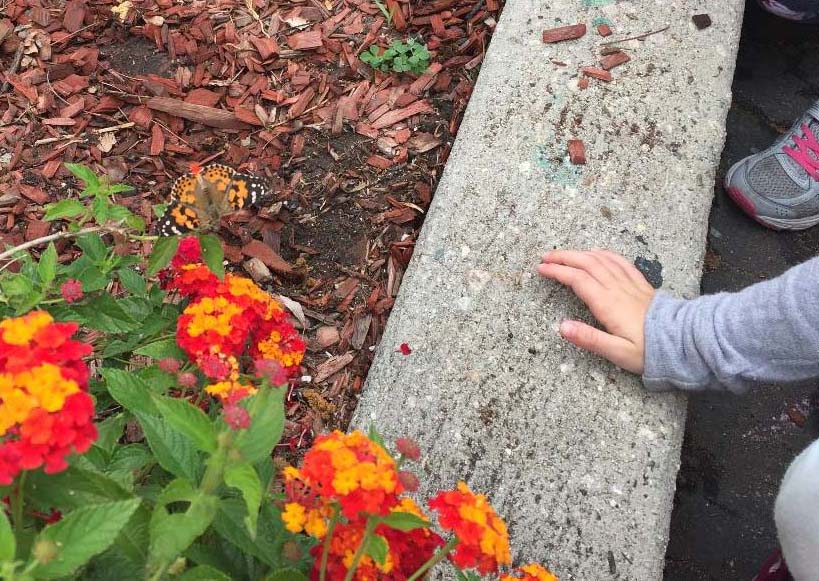
Painted Lady butterfly resting near lantana flowers
After we went back inside I read my story THE TERRIBLE HODAG AND THE ANIMAL CATCHERS. Later, the students will create their own “mixed up animals.”
Reading THE TERRIBLE HODAG AND THE ANIMAL CATCHERS. The Hodag has the head of an ox, feet of a bear, back of a dinosaur and tail of an alligator.
We also talked about chickens and eggs and I shared my ostrich egg, comparing its size to a chicken egg. Sitting on a shelf at the front of the classroom was an incubator filled with chicken eggs. In about two weeks they will hatch. Meanwhile, the children can read my book HATCHING CHICKS IN ROOM 6, about a previous kindergarten class that hatched eggs with Mrs. Best.
Incubator with chicken eggs
I always enjoy visiting Room 6 and seeing all the amazing science projects that Mrs. Best is doing with her students. I thank her for taking the photos during my visit.

Tuesday, March 12, 2019

HOORAY! It’s Publication Day for BUTTERFLIES IN ROOM 6

HOORAY! Today is the official publication day for BUTTERFLIES IN ROOM 6, my new book about a kindergarten class raising painted lady butterflies. BUTTERFLIES IN ROOM 6 follows a class of kindergartners as they raise butterflies--from tiny eggs, to caterpillars, to chrysalises, to beautiful butterflies, before releasing them in the school garden. 
I thank all the people at Charlesbridge Publishing who helped make this such a terrific book–my wonderful editor Alyssa Pusey, Susan, Joyce and Sarah for the book design, Yolanda, Karen, Julie, Diane, Cathy and everyone else who contributed to making this such a special book.
I couldn’t have written BUTTERFLIES IN ROOM 6 without the help of Jennifer Best and her kindergarten students at Haynes Charter for Enriched Studies in Los Angeles, California. I thank them for welcoming me into their classroom and for sharing the wonder of metamorphosis with me. Their excitement was contagious as they watched the caterpillars transform into beautiful butterflies. I am also grateful to the children’s parents and the school principal, Barbara Meade, for their enthusiastic support.
It was great to work with Jennifer Best again. Two years ago I followed her class as they hatched eggs and learned about the life cycle of chickens. That experience became my book HATCHING CHICKS IN ROOM 6. Now we have a sequel! I am excited that it is now available to the public. Look for it at your favorite bookstore or online.

BUTTERFLIES IN ROOM 6

Tuesday, January 15, 2019

KIRKUS REVIEW of Butterflies in Room 6

I am pleased to have another good review of my new book, Butterflies in Room 6, this time in Kirkus Reviews.

BUTTERFLIES IN ROOM 6:  See How They Grow
Author: Caroline Arnold
Photographer: Caroline Arnold

Review Issue Date: February 1, 2019
Online Publish Date: January 15, 2019
Publisher:Charlesbridge
Pages: 40
Price ( Hardcover ): $16.99
Publication Date: March 12, 2019
ISBN ( Hardcover ): 978-1-58089-894-2
Category: Informational

Arnold revisits Mrs. Best's elementary classroom (Hatching Chicks in Room 6, 2017) for this look at the life cycle of the painted lady butterfly. Arnold uses the class's study of butterflies to present readers with solid facts about these insects in both the main text and leaf-shaped fact boxes. Mrs. Best's butterfly eggs come in a tube (she must have purchased them, though this is not addressed). The entire life cycle is both pictured and described in the next spread. The close-ups of the eggs in their different stages of hatching are sure to fascinate. On release day, each child gets to hold a butterfly that has crawled onto their hand. Though this book focuses on butterflies in a classroom, families could easily use this information to safely raise butterflies at home (several tips are given about keeping the insects alive and free from injury). The back matter includes a page of answered questions about butterflies, a glossary, and a list of both online and text resources for finding further information. Arnold's photos are a highlight, combining candid shots of the diverse students and their white teacher with pics of the insects, both in captivity and in nature. Labeled close-ups bring readers into the classroom and teach butterfly anatomy. A solid look at the butterfly life cycle that will have students asking their own teachers to host caterpillars in their classrooms. (Informational picture book. 4-9)

Wednesday, June 6, 2018

NEW CHICKS: Author Visit with Campbell Hall Kindergarten Students, Los Angeles, CA

Day-old chicks in the Kindergarten classroom at Campbell Hall
When I first met librarian Linda Pechin at the CLCSC workshop two weeks ago and she told me that the kindergarten students at her school, Campbell Hall, were hatching chicks in their classrooms, it seemed like the perfect opportunity for an author visit. So Linda arranged it, and on Thursday last week I went to the school and had a wonderful time.
Caroline with Linda Pechin, Librarian at Campbell Hall
Both classrooms had incubated eggs so there were two sets of day old chicks peeping in their cages. The children had read my book HATCHING CHICKS IN ROOM 6 and we talked about how their process was similar to that described in the book. We also talked about how they know that chickens are birds–they have feathers and they lay eggs–and then I showed them my feather collection and measured their wingspans. I also shared my ostrich egg. Everyone was impressed that it takes 42 days for an ostrich egg to hatch–twice as long as a chicken egg. The visit ended with a story from my WIGGLE AND WAGGLE book and singing the gardening song. I then went to the library to autograph books.
I thank Linda Pechin and the kindergarten teachers and their students for a very enjoyable visit at Campbell Hall.

Wednesday, April 11, 2018

Author Visit with Kindergarteners at Westwood Charter School in Los Angeles

Westwood Charter School, Los Angeles, CA
Yesterday I had a fun visit with the kindergarten students at Westwood Charter School in Los Angeles, California, and shared my book Hatching Chicks in Room 6. It was an appropriate choice because they are also hatching eggs–except that they have duck eggs in their incubator. Several of the eggs already had pips so it won’t be long before the ducklings hatch. (Duck eggs take 28 days to hatch whereas chicken eggs hatch in 21 days.) I had a lively discussion about birds with the students, showed them my feather collection, and measured their wingspans. I found out that they will be celebrating Audubon’s birthday later this month. At the end of my visit I read the first two stories of Wiggle and Waggle and the children helped me sing the song.
Thanks to kindergarten teacher Sherry Kaufman for inviting me to her classroom. I enjoyed my visit.

Wednesday, March 28, 2018

Caroline Arnold interview with Cybils:


After my book Hatching Chicks in Room 6 won the Cybils Award for Elementary Non-fiction, I did an interview with Cybils blog editor Melissa Fox. It was published on the Cybils blog on March 27, 2018. Caroline Arnold interview with Cybils:

Do you have plans to keep chickens after learning about their care along with Room 6?

A number of years ago, before I moved to Los Angeles, I lived in the country with my family and we kept a flock of chickens. Watching the children in Room 6 care for their chickens reminded me of this experience. Now that I live in the city, it is not practical to keep chickens, so the answer is no, I do not have plans to keep chickens.

What do you think is the most valuable thing students learn from studying chickens in the classroom?

Among the many valuable lessons learned from hatching chicks in the classroom is being able to witness the life cycle process–from incubating the eggs, to seeing the shells break open, to watching the chicks grow from fluffy balls to fully feathered chickens. It is one thing to be told that chicks grow in eggs, but another to actually see an egg hatch with your own eyes.

How do you keep your research organized?

I have a box system to keep my research organized. Each book I write has its own box, which is where I put my notes, letters, brochures, print-outs from my computer, and anything else pertinent to the book. My digital photos are kept in folders in my computer.

What challenges did you face working with photos instead of your usual collage illustrations?

Every photographer will tell you that the two most difficult subjects are children and animals-- because they don’t stay still and they don’t take direction! My secret was to take LOTS of pictures. The challenge of a book like this is that the story takes place in real time so I had to get the photos I needed as they happened. There was no going backwards. Photographs give an immediacy to the story and help make the reader feel part of the action.

If you don’t mind telling us, what’s next for you?

When I was in Mrs. Best’s classroom working on Hatching Chicks in Room 6, I noticed that the children were also learning about insects and the process of metamorphosis. It occurred to me that this could be the topic of another book. So the following year I was back in Room 6 learning about painted lady butterflies and how they grow from tiny eggs to beautiful adult butterflies. That book, Butterflies in Room 6, will be published in January 2019.

Wednesday, June 7, 2017

HATCHING CHICKS IN ROOM 6 at the Pioneer Bookshop in Grinnell, Iowa

On my recent trip to Grinnell, Iowa, for a college reunion, I stopped in at the college bookstore, the Pioneer Bookshop, now located in historic downtown Grinnell, to show them my new book, Hatching Chicks in Room 6. I was delighted to discover that they had already ordered it and put it on the shelf. I then went down the street to the town library, in a beautiful large building, new since my last visit to Grinnell, and found out that they had also already ordered it for their collection. (The old library building is now used as an art gallery.) I had a nice chat with the children's librarian who told me that she loves using my books in her story hour. Perhaps I shouldn't be surprised that a book about eggs and hatching chicks is popular in a community surrounded by farms and which owes its history to a tradition of farming. It seems like the perfect place for my book.

Wednesday, March 22, 2017

Egg-Citing Activities for Kids, Part 1: Eggshell planter

In celebration of spring and my new book Hatching Chicks in Room 6, I will be posting a series of egg and chicken related projects and activities for kids. I'm starting with a repost of my Eggshell Planter project from June 2014:

One of my first illustration assignments was for a book about gardening activities with children.  At that time, most books for children were illustrated with black and white art so I made pencil drawings.  Here is one of the activities meant for younger children.  It would work well with pre-school or kindergarten children.

EGG HEAD PLANTER
Break away 1/4 of the pointed end of an egg shell, and empty the contents.  Have the children draw a face on the shell using felt pens, then fill the shell with moist soil and plant chives or wheat seed.  Make a stand from a cardboard egg carton. Place the egg head in the stand.  Water lightly each day.

Materials needed: Cardboard egg carton, eggs, felt pens, soil, chives or wheat seed.

From Children’s Gardens: A Field Guide for Teachers, Parents and Volunteers by Elizabeth Bremner and John Pusey, Illustrations by Caroline Arnold

Tuesday, January 10, 2017

NEW BOOK! Hatching Chicks in Room 6, Official Publication Day

HATCHING CHICKS IN ROOM 6, Text and Photos by Caroline Arnold (Charlesbridge, 2017)
TA-DAH! Today is the official publication day of HATCHING CHICKS IN ROOM 6!
On May 12, 2014, I was invited to do an author visit to Haynes Center for Enriched Studies elementary school in West Hills, California, in honor of Amy Werner, a librarian who had worked for many years in schools in the area. After my presentation, Jennifer Best, a kindergarten teacher at Haynes, asked me if I had ever written a book about hatching chicks. Each spring, she brought eggs to her classroom and hatched chicks. But, she told me, she couldn’t find any books that were written at the right level for her kindergarten students. I said I hadn’t written any books about chickens, although I had written a number of books about other kinds of birds. I liked the idea of a book about hatching chicks, and a year later I was in Mrs. Best’s classroom learning about eggs and chicks and documenting the process with photos. HATCHING CHICKS IN ROOM 6 is the result of that project.

I thank Jennifer Best and her students for sharing their chick hatching experience with me. The children’s enthusiasm was contagious as they learned about chickens and eggs and cared for the growing chicks. I am extremely grateful to Jennifer for her wealth of knowledge about hatching chicks in the classroom. I couldn’t have done the book without her. I also thank the children and their families for their cooperation throughout the process. The fourteen chicks who are the stars of the book are now adult chickens. It was a remarkable journey watching them hatch and grow.
I also thank my editor Alyssa Pusey for her careful editing of the text, art director Susan Sherman for the very attractive and readable design of the book, and all the staff of Charlesbridge for their contributions to the project.
HATCHING CHICKS IN ROOM 6 is available as both a hardcover book and an ebook. For details click HERE.
For more about the book, go to the Hatching Chicks page at my website: http://www.carolinearnoldbooks.com/hatchingchicks.html

Wednesday, October 12, 2016

HATCHING CHICKS IN ROOM 6: Coming January 10, 2017!

I am delighted to have an advanced copy of my new book Hatching Chicks in Room 6 (Charlesbridge, 2017.) I think it looks terrific!  (It is already available for pre-order on Amazon.) Stay tuned for more about the book after the official publication date, January 10, 2017.

HATCHING CHICKS IN ROOM 6
Author: Caroline Arnold
Photographs by Caroline Arnold
Age: 3-7 years
Pages: 40
Publisher: Charlesbridge Publishing, 2017 (available January 10, 2017)
ISBN: ( Hardcover ): 9781580897358

From the flap:
In 21 days, chicks will hatch in Room 6! A hen laid the eggs. Mrs. Best brought them to school and put them in an incubator. Soon the chicks will PECK, PUSH, and POP! right out of their shells. The kindergarteners are counting down to hatching day. When it happens, they'll be ready.

Follow a classroom of kindergartners as they participate in a popular activity: hatching chicks. Readers learn about the life cycle of a chicken, incubating eggs, watching them hatch, and raising the chicks until they are old enough to return to the chicken coop.

Simple text and close-up photographs tell the story. Back matter includes answers to questions about chicks, chick vocabulary, links to chicks online and further reading about chicks.