Showing posts with label projects. Show all posts

Monday, August 24, 2026

DRAWING DINOSAURS WITH GLUE: Projects and Activities Inspired by My Books


During my nearly fifty years as a published author I have visited hundreds of schools to talk about my books and what it is like to be an author. I am always impressed by the creative projects teachers have done with their students in connection with my books. When kids do these projects it reinforces the concepts of the book and expands their impact. Over the next few weeks/months I will share some of these projects on this blog.


Dinosaur projects never grow old. At one school I visited the students had used Elmer's Glue to draw the outline of their favorite dinosaurs on black paper. After the glue dried and became transparent, they filled in the rest of the drawing with pastel crayons. The bumpy glue outlines gave the dinosaurs a 3-D look and suggested their scaly bodies. And the dark background provided an eerie quality as if we were looking into the past.


The students had read my book Dinosaurs All Around, about an artist who creates dinosaur models for museums. Some of my other books about dinosaurs include Dinosaur Mountain and Dinosaurs Down Under. You can find all these books as e-books on Amazon.


Monday, August 17, 2026

LIFE-SIZE PAPIER MACHE SHARK: Projects and Activities Inspired by My Books

Paper Mache Model Shark.

During my nearly fifty years as a published author I have visited hundreds of schools to talk about my books and what it is like to be an author. I am always impressed by the creative projects teachers have done with their students in connection with my books. When kids do these projects it reinforces the concepts of the book and expands their impact. Over the next few weeks/months I will share some of these projects on this blog.

One of my all-time favorite projects inspired by my books is the life-size papier mache shark created by fourth graders at a school in California. Making a model like this requires close observation of the shark's body shape and characteristics. Sharkeel O'Neal remained in their classroom long after my visit, reminding the students of my author visit and all they had learned about sharks from my books.

My books about sharks include Watch Out for Sharks illustrated with photographs by Richard Hewett and Giant Shark: Megalodon, Prehistoric Super Predator  illustrated with beautiful watercolor paintings by Laurie Caple. Both books are available is e-books on Amazon.


Monday, August 10, 2026

FOSSILS FROM THE ICE AGE: Projects and Activities Inspired by My Books

Model tar pit with fossil bones made of clay.

During my nearly fifty years as a published author I have visited hundreds of schools to talk about my books and what it is like to be an author. I am always impressed by the creative projects teachers have done with their students in connection with my books. When kids do these projects it reinforces the concepts of the book and expands their impact. 
Over the next few weeks/months I will share some of these projects on this blog.

Model tar pit with Fossil "bones" made of clay:

One of my all-time favorite school projects is a model tar pit made by fourth grade students studying California history. After reading TRAPPED IN TAR: Fossils from the Ice Age, they created fossil bones of Ice Age animals--mammoths, sabertooth cats, camels, dire wolves and more. The teacher made a tar pit by slathering roofing tar on a piece of plywood. Then the students embedded their "fossils" in the tar for a realistic depiction of the La Brea Tar Pits in miniature. (The dinosaur on the edge is a mistake--dinosaurs lived millions of years earlier.) 

As part of the project each student wrote a poem. Here's a sample.

Trapped in tar,

Stuck in goo,

With bundles of others,

Sticky as glue.

Stuck as can be,

They try to get out,

Twisting and turning

Knowing they will die without a doubt.

You can learn more about the fossils of the La Brea Tar Pits and life in Southern California during the Ice Age in my book TRAPPED IN TAR: Fossils from the Ice Age, available in both paperback and as an ebook.


Thursday, August 6, 2026

LIFE-SIZE CALIFORNIA CONDOR MODEL: Projects and Activities Inspired by My Books

Life-size California condor model.

During my nearly fifty years as a published author I have visited hundreds of schools to talk about my books and what it is like to be an author. I am always impressed by the creative projects teachers have done with their students in connection with my books. When kids do these projects it reinforces the concepts of the book and expands their impact. 

Over the next several weeks I will share some of my all-time favorite book related projects on this blog.

Life-size condor model:

The California condor is the largest flying bird in North America and has a wingspan of more than 11 feet. A third-grade class made this impressive life-size model with construction paper. Every single feather was cut out separately and glued on. Condor facts are displayed above. I'm sure that the students will remember creating the condor, long after my visit to their classroom. 

You can learn about the California condor and the efforts being made to save it from extinction in my book ON THE BRINK OF EXTINCTION: The California Condor, available as an ebook on Amazon.


Wednesday, May 13, 2026

READING WIGGLE AND WAGGLE: “BOOKS AND BAGELS” at Apricot Lane Farms, Moorpark, CA

Signing books at Apricot Lane Farms "Books and Bagels" event.

I spent last Saturday morning at Apricot Lane Farms in Moorpark, California, sharing my books at an event for children and parents called “Books and Bagels”. While seated on blankets on a grassy lawn and munching on breakfast, they listened to me talk about being an author and about my books. 

We were in the midst of a thriving organic farm, so it was fitting for me to share my Room 6 books, HATCHING CHICKS IN ROOM 6, BUTTERFLIES IN ROOM 6 and PLANTING A GARDEN IN ROOM 6 and also WIGGLE AND WAGGLE. At the end of the program I signed copies of WIGGLE AND WAGGLE and PLANTING A GARDEN IN ROOM 6, which were for sale in the Garden Shop.

Note: Directions for making stick puppets, singing the Wiggle and Waggle song, and other wormy activities are downloadable HERE.


I thank Liz Davis, Tours and Events Manager, for inviting me to share my books at Books and Bagels and who coordinated all the details of my visit. It was a pleasure to read my books and I was pleased that so many people bought them afterward. I also thank Kristen Nordstrom, who put on my Wiggle and Waggle sock puppets and acted out the story as I read aloud. She also was a great help handing out materials at the end of the program. (Everyone took home supplies to make their own Wiggle and Waggle stick puppets.) Kristen is a teacher at the school on the Apricot Lane Farms campus. She is also a children’s book author and shared her book Mimic Makers at a previous Books and Bagels program.

Kristen Nordstrom with my Wiggle and Waggle puppets.

The Books and Bagels program is a great way to celebrate books and reading and for families to discover the amazing plants and animals of Apricot Lane Farms. You can go to their website to find out more about it and how to visit.

Entrance to the Garden Area of Apricot Lane Farms


Monday, May 19, 2025

ROCK ART BY ANCIENT AMERICANS: Activities for the Classroom

Rock art (petroglyphs) at Red Rock Canyon, Las Vegas, Nevada.

At Red Rock Canyon near Las Vegas, Nevada, and at many other places in the American West, ancient Americans created images on rocks.  Some are engraved on the rock surfaces. They are called petroglyphs. Others are "painted" on the rocks and are called pictographs. I saw both on my recent visit to Red Rock Canyon. Some of them are believed to be as much as 800 years old.

Hand prints at Red Rock Canyon.

Here is the link to activities to do with students to learn about rock art and gain appreciation of the rock art at Red Rock Canyon.

https://www.blm.gov/sites/blm.gov/files/uploads/Nevada-Red%20Rock%20Canyon-Rock%20Art.pdf

You can learn more about rock art of the American West in my book STORIES IN STONE: Rock Art Pictures by Early Americans.  

Monday, March 31, 2025

THINK OUTSIDE THE BOOK: Presentation to Teachers at the Southern Nevada Early Childhood Conference

My exhibit table at the Southern Nevada Early Childhood Conference, Las Vegas, Nevada.

I spent an enjoyable day last Saturday with Pre-K, Kindergarten and First Grade teachers at the Southern Nevada Early Childhood Conference in Las Vegas, Nevada, an annual meeting attended by teachers from all over the state. This year’s theme was “Growing Young Learners.” I gave a presentation called “Think Outside the Book: Projects and Activities Reinforce Reading” to an enthusiastic audience, sharing many of the projects inspired by my books that have been used in classrooms over the years, ranging from songs, art projects, science experiments, hands-on activities, and much more. I also had a table with the other conference vendors where I could chat with teachers during their breaks between sessions and where they could buy my books. 

I thank Suzie Hindrichson of the Southern Nevada Professional Development Program and her volunteer staff for inviting me and for doing an excellent job of organizing the conference. I don’t get to Nevada very often, and it was a pleasure to be able to connect with so many educators at the conference. A bonus of the trip was the opportunity to visit Red Rock Canyon, a magnificent conservation area just outside Las Vegas, which I did on the day before the conference. Look for my report about that soon on my travel blog, The Intrepid Tourist.

One of the many hiking trails at Red Rock Canyon.

Caroline at Red Rock Canyon


Monday, April 1, 2024

SUN FUN: GET READY FOR THE ECLIPSE Coming On APRIL 8, 2024! 10 Projects for Kids


On Monday, April 8, 2024, a solar eclipse will be seen over North America. The path of the full eclipse will pass over 13 states and a partial eclipse will be seen in many more.

It is never safe to look at the sun directly. Here's how you can experience an eclipse safely. This project is in my book Sun Fun, originally published in 1981 by Franklin Watts, and now available as an e-book on Amazon or downloadable on Epic at your school or library.

Sun Fun includes 10  projects for primary school age children to learn about the sun-- a paper plate clock to tell time by the sun, how to make shadow puppets and solar art, creating a pin-hole card for watching an eclipse, and much more. You can preview the book in this video on YouTube about how to make a sun clock. (The illustrations in the book are my own, created in the days of pre-separated art. I had to make a separate drawing for each printed color!)
Enjoy learning about the sun and  watching the eclipse safely!

Thursday, March 28, 2024

I LOVE THANK YOU NOTES!

Thank You card from student at Esperanza School, Los Angeles, CA

A wonderful package arrived in the mail the other day, filled with thank you notes from the students at Esperanza School, where I had visited 3rd and 4th graders about a month ago. 

In this card I am depicted in front of the giant TV screen I used to present my slides.

During my visit I gave a slide presentation showing my books, my life as an author, and a little bit about me growing up.


Another student created an illustrated book with chapters.

I then showed them how books are made and we did a short exercise in which they folded a sheet of paper to make a tiny blank book. I discovered that after my visit they had turned their little blank books into thank you notes. Each one was different and delightful. I was thrilled to see how much the students had absorbed from my presentation.


Many wrote about their favorite book.


One student made a wonderful illustrated guide for making a tiny book! Get a paper. Fold paper. Fold paper again. Finished!


When I was growing up I never had the opportunity to meet a real live author at school. Cards like these show me what an impact a visit from an author can have on students. I thank teacher Elizabeth Williams for sharing the students' cards with me. They are all wonderful. These are just a few samples. 


Thursday, February 29, 2024

MY FRIEND FROM OUTER SPACE: Fun Activities for Kids


MY FRIEND FROM OUTER SPACE
In this new graphic picture book Sherry tries to convince her friend that she comes from outer space. But does she? Join Sherry and her friend as they zoom through space at a zillion miles an hour. Here are some activities you can do after reading the book.

ACTIVITIES

1. Let’s pretend. Pretending is a good way to get an idea for a story. Write or tell your own story.

2. Make up your own language. What do you think Glug, flug, Tinbambam means in the story?

3. Make your own space ship with a cardboard box.

4. Create your own outer space costume. Do you look like a monster from outer space?

5. Design a quilt square from a scene in the book. Make a class quilt.

6. Create a comic strip. Put the words in speech balloons.

7. Make a model of the planetary system. What planets did Sherry and her friend see in outer space?

8. Perform a puppet play of the story. Make stick puppets or paper bag puppets.


MY FRIEND FROM OUTER SPACE

By Caroline Arnold Illustrations by Paige Arnold

ISBN 9798399935614 Paperback $9.99

ASIN B0CB9BXWLC Kindle ebook $6.99

Available at Amazon or to order at your favorite book store.


The book is also available in Spanish as MI AMIGA DEL ESPACIO. ISBN 9798870320717

For more about the book go to www.carolinearnoldbooks.com/myfriendfromouterspace.html

Wednesday, August 16, 2023

A DINOSAUR IN THE LIBRARY! Art and Writing Projects Make Books Come Alive

Papier Mache Stegosaurus model in school library.

In the good old days of my author visits to schools (the 1990s), everyone had read at least one of my books before my visit, and every classroom had done some kind of project inspired by a book. By the day of my visit the excitement was palpable and the hallways, auditorium, and library were filled with student projects—ranging from poems, songs and stories, to paintings, drawings and scale models. I always brought my camera. Recently, while cleaning out I found some of those photos.

Dinosaurs are always a favorite with kids and my book DINOSAURS ALL AROUND (Clarion, 1992) inspired many projects. One of my favorites was the papier mache stegosaurus mounted in the school library. While not as large as a real stegosaurus, it certainly brought a Jurassic atmosphere to the library and for the students, helped bring the content of the book to life. Just ike Steven Czerkas, the dinosaur artist portrayed in the book, they had created a dinosaur model.

Dinosaurs All Around (Clarion, paperback 1997; hardback 1993.) Out of Print. Available digitally at Amazon.

Stephen Czerkas's dinosaur models, ranging from the largest carnivores to hatching babies, are widely exhibited in museums. This book is based on a traveling exhibit, "Dinosaurs: A Global View," organized by the Natural History Museum of Los Angeles County and a visit to the artist's studio.

Note: Many schools still do wonderful projects as preparation for my author visits and I am always impressed by the creativity of teachers and students. But there seems to be less time now in the school day for extra projects than there once was, and I don't see as many as I used to.


Thursday, April 7, 2022

CELEBRATING PLANTING A GARDEN IN ROOM 6 at HAYNES SCHOOL, Los Angeles, CA

Caroline with Jennifer Best, Haynes Center for Enriched Studies, Los Angeles, CA

Monday was the Big Day, celebrating the publication of PLANTING A GARDEN IN ROOM 6: From Seeds to Salad with Mrs. Best and the children in her 2019-2020 kindergarten class at Haynes School in Los Angeles, who are pictured in the book. The kids are now in second grade! At a special program in the school auditorium (my first in person school event in two years!) with all the second graders and Mrs. Best's current kindergarten class, I presented Mrs. Best with a hat and mug along with her book.

Then I presented each child from Mrs. Best's class with their own autographed book. It was wonderful to see the happy looks on their faces!  For the occasion I wore my new vegetable t-shirt!
My book Wiggle and Waggle is the perfect companion book for Planting a Garden in Room 6


Before presenting the books I did a short author talk (which included singing the Wiggle and Waggle song with my sock puppets) and read the book. The kids then had a chance to ask questions and make comments before the book presentation.  My favorite: "The vegetables we grew are my favorite vegetables to eat!"

I was surprised to see how much the kids had grown. Some are almost as tall as I am!
I am so glad that the book is finally out and I am able to promote it. Thank you Mrs. Best and all the students for sharing your gardening experience with me and being part of the book. And a special thanks to Barbara Meade, the school principal for your support and enthusiasm for the project!


Wednesday, March 30, 2022

THE PLANT CYCLE: Foldable Project Teaches the Plant Growth Cycle, by Debbie Gonzales at LitLinks

Project by Debbie Gonzales at LitLinks
I discovered this easy foldable project by guest blogger Debbie Gonzales at LitLinks (Patricia Newman's blog linking literature and STEM.) It is perfect to use in conjunction with my new book PLANTING A GARDEN IN ROOM 6: From Seeds to Salad. It introduces children to the stages of plant growth from seed to maturity in a simple folding paper project. https://www.patriciamnewman.com/litlinks-easy-foldable-activity-to-illustrate-the-plant-cycle/

Debbie's project was created for the new book  NIGHT BECOMES DAY: CHANGES IN NATURE, written by Cynthia Argentine . 


Saturday, October 10, 2020

LITLINKS GUEST POST: Kids See Chicks Hatch With Their Own Eyes

This article first appeared on September 16, 2020, as a guest post at Patricia Newman's blog, LitLinks, Authors, Educators, Scientists sharing the natural connections between STEM and Language Arts. 


Life Cycle Reinforces Reading:

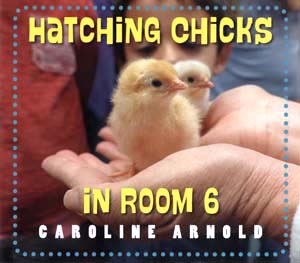
In 21 days, chicks will hatch in Room 6! A hen laid the eggs, and Mrs. Best brought them to school and put them in an incubator. Soon the chicks will PECK, PUSH, and POP right out of their shells. The kindergarteners are counting down to hatching day. When it happens, they’ll be ready.
Among the many lessons learned in HATCHING CHICKS IN ROOM 6 is the life cycle process–from incubating the eggs, seeing the shells break open, to watching the chicks grow from fluffy balls to fully feathered chickens. It is one thing to be told that chicks grow in eggs, but another to actually see an egg hatch with your own eyes. This photo essay follows an egg from the time it is laid in the henhouse, through the incubating and hatching process in a school classroom, to the time when the chicks are ready to go back to the flock. Children observe the eggs and chicks up close as they learn firsthand about a chicken’s life cycle.

Strategies for reading Hatching Chicks in Room 6:


Main text: The text of HATCHING CHICKS IN ROOM 6 is written on two levels—the main narrative, printed in larger type, and sidebars, printed in smaller type. Headings are red and in capital letters for emphasis. What is the effect of telling the story in the present tense? Does it make you feel as if you are participating in the process?
Sidebars and captions: The sidebars and captions add information, provide the opportunity to introduce more difficult vocabulary, and expand on material in the main text. Note that the sidebars are printed over a photo of an egg, reinforcing the theme of the book.
Photos: “Reading” the photos is an important part of understanding the book. Photos:
  • Add information to the story (such as showing what an incubator looks like),
  • Show the children in their environment (in the classroom and outside in the chicken pen),
  • Provide a sense of scale (we see the size of a newly hatched chick as it rests in a child’s hand), and
  • Enlarge details for a closer look (the parts of a chick’s body).
  • The photos also reveal the children’s emotional response to the chicks. We see and share their sense of wonder as they participate in each step of the process.
Back matter:  Back matter includes answers to questions about eggs and chicks, vocabulary, links to online information about hatching chicks, and a list of books for further reading.

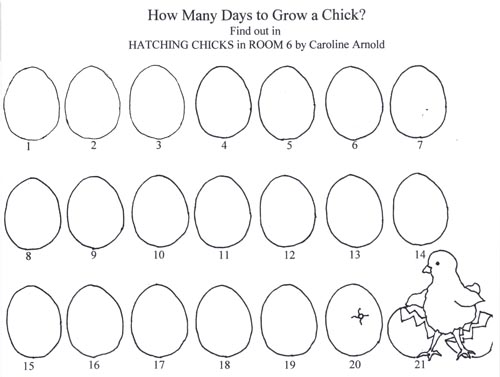
Hands-on: How many days to hatch a chick?

The events of the story in HATCHING CHICKS IN ROOM 6 occur in chronological order. You can use these events to create a time line, beginning with the day the eggs go into the incubator.  Click HERE for a downloadable coloring page.

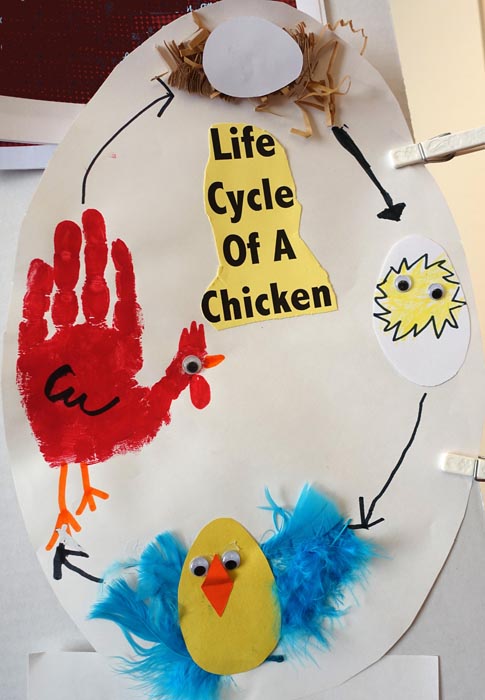
Which came first, the chicken or the egg?

In one classroom of second graders, the children made a mixed media presentation to show the life cycle of a chicken. They used packing material to represent the chicken’s nest, real feathers to represent the growing chick, a hand-print for the body of an adult chicken, markers for drawing, and googly eyes for all. Mounted on a large poster board cut into an egg shape, with black arrows drawn to indicate the circular process, it is a dramatic and colorful presentation.

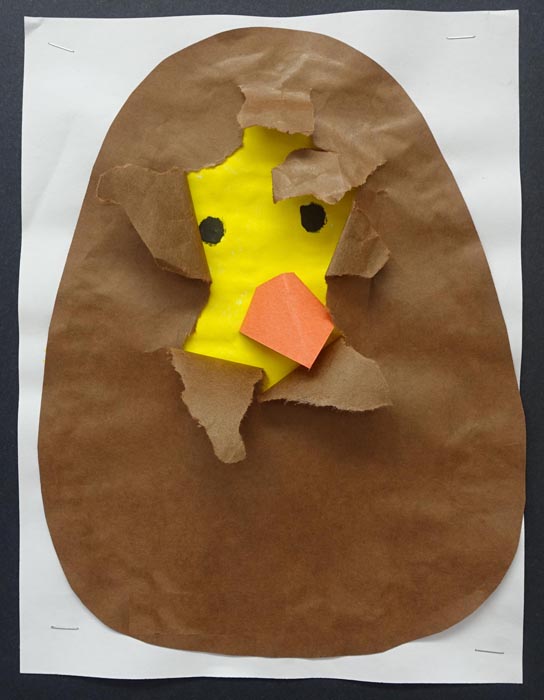
Ready to hatch!

When a chick is ready to hatch, it uses its beak to poke a hole in the shell.
For this project you will need: Construction paper, pencil, scissors, glue, black marker.
1. Cut out two large egg shapes from yellow and brown paper. Cut a small hole in the middle of the brown paper. Glue the egg shapes together around the edges.
2. Carefully tear back the hole in the brown paper, pulling the pieces to reveal the yellow paper underneath.
3. Use a marker to draw two black eyes. Cut a triangle of orange paper and fold in half to make a beak. Glue it on.
Now your chick looks like it is ready to hatch!

Caroline Arnold has been writing since 1980 and is the author of 170 books for children, including  Butterflies in Room 6 (2019) and companion book Hatching Chicks in Room 6 (2017), a JLG Premier Selection and CRA Eureka Award winner. She illustrated both books with her own color photos. Other recent titles include A Day and Night in the Rain Forest in her Habitats series, illustrated with her own cut paper art. A noted science writer, Caroline Arnold has had thirty-three books on the NSTA Outstanding Science Trade Books list including Too Hot? Too Cold? and  A Warmer World. Her books are inspired by her travels, her love of animals, fossils, and the out-of-doors. She lives in Los Angeles, California. www.carolinearnold.com

Wednesday, August 5, 2020

FIFTY NIFTY PROJECTS FOR KIDS

Are you looking for something to do while school is out for summer vacation? At my website you can find FIFTY NIFTY PROJECTS that you can do in connection with reading my books. Most of the the projects use materials easily found at home or at school. They range from writing a pyramid poem to putting stripes on a zebra (cut paper art) to simple science experiments like finding out how icebergs affect sea level.

Go to My Books at my website to find more information about the books that inspired these projects. Many of the books are available as e-books that you can download from Amazon and other platforms.

Have fun!
Here are a few examples of the projects you can do:
Curlycue Snakes
(Read SNAKE or A DAY AND NIGHT IN THE DESERT)
Make a model of the Taj Mahal
(Read TAJ MAHAL)

Peanut Butter and Jelly Geology
(Read TRAPPED IN TAR or GLOBAL WARMING AND THE DINOSAURS)