Showing posts with label Haynes School. Show all posts

Monday, May 5, 2025

HOW DOES YOUR GARDEN GROW? A Visit with Mrs. Best’s Kindergarten Class, Haynes School, Los Angeles, CA

School Garden 2025, Haynes Charter Elementary, Los Angeles, CA.

In the spring of 2022, my book PLANTING A GARDEN IN ROOM 6, the story of Mrs. Best’s kindergarteners and their school garden, was published by Charlesbridge. 


Last week I visited Mrs. Best’s to see how this year's garden was growing and to share some of my books with the students. The garden looked terrific with the peas, beans, carrots, lettuce, onions, tomatoes, and a patch of white alyssum, all growing like gangbusters. Earlier in the week the children had harvested the radishes—always the first to be ripe for picking.


In the classroom, the students are hatching eggs, which were in their ninth day of incubation on the day of my visit. They are scheduled to hatch on May 13. I read my book HATCHING CHICKS IN ROOM 6, which documented the children of Mrs. Best’s class of 2015 as they hatched eggs. After reading the book we talked about feathers and eggs. I measured the children's wingspans--most were peregrine falcons--and showed them my ostrich egg.


The students will also be growing butterflies, the topic of my book BUTTERFLIES IN ROOM 6. Their caterpillars had just arrived in the mail and the students will watch them grow, form chrysalises, and emerge as painted lady butterflies.


Soon the children will be adding earthworms to their garden. I finished my visit by reading WIGGLE AND WAGGLE and having the children sing the Wiggle and Waggle gardening song with me. It was a fun morning.

It is always a pleasure to visit Mrs. Best’s classroom at Haynes School. I love the way she does so many hands-on science projects with her students and to see their enthusiasm for them. I can’t thank her enough for her cooperation and collaboration with my Room 6 books. 
Caroline and Jennifer Best


Tuesday, March 15, 2022

PUBLICATION DAY! PLANTING A GARDEN IN ROOM 6: From Seeds to Salad


Happy Book Birthday! Hooray! Today is the publication day for my new book PLANTING A GARDEN IN ROOM 6: From Seeds to Salad (Charlesbridge, 2022), the third book in my Life Cycles in Room 6 series. With many thanks to my editor, Alyssa Pusey, for guiding another book through the editing and publication process and helping me to hone my text, and to Cathleen Schaad for her brilliant design of the book. And many, many thanks to Jennifer Best for welcoming me into her classroom and working with me on yet another Room 6 book, to the children and their families for their cooperation and enthusiasm for this book, and to Mrs. Meade, principal of Haynes Charter for Enriched Studies, for her support of the project.

Caroline and Jennifer Best

It has been a long two years since the children in Mrs. Best's kindergarten class planted their school garden. They are now in second grade. We are planning a party soon to celebrate the book. I look forward to presenting each of them of a signed copy.

Wednesday, May 15, 2019

AUTHOR VISIT IN ROOM 6, Haynes School, Los Angeles, CA

Releasing painted lady butterflies with students in Room 6
Yesterday I visited Mrs. Best and her students in Room 6 at Haynes School in Los Angeles. In March I had presented my new book BUTTERFLIES IN ROOM 6 to the whole school. This time I did a class visit.  Earlier this spring I had raised butterflies to take to my book signings to celebrate the publication of the book. Those butterflies laid eggs before I let them go, thus producing a second generation.
Painted Lady butterfly eggs, magnified. The actual size is about as big as a grain of salt.
By yesterday the new butterflies were ready to fly free. With the students in Room 6 I went out to the school garden and the children helped me let the butterflies go.
Butterflies drinking orange juice with their proboscises.
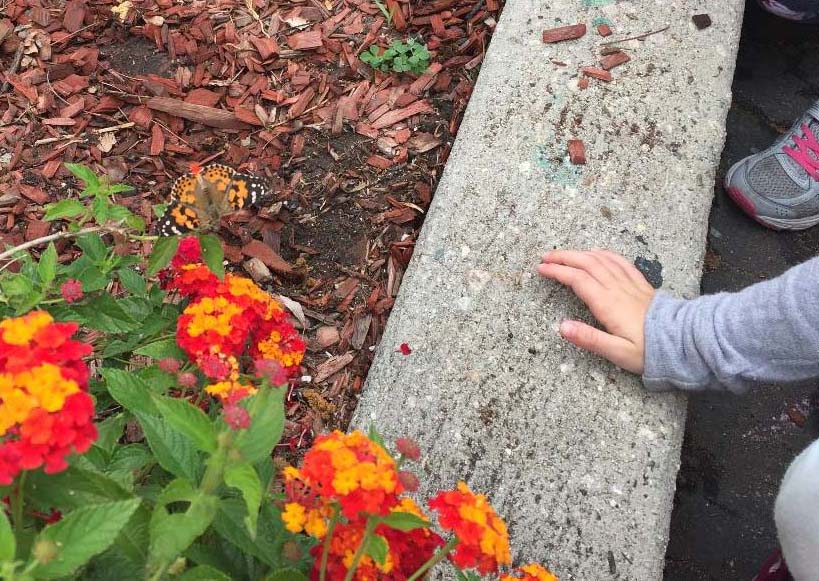
As I took the butterflies out of their netted enclosure, some sat for a few seconds on eager fingers. Then, whoosh, they flapped their wings and took off. Some flew over the fence and others landed on flowers in the garden.
Painted Lady butterfly resting near lantana flowers
After we went back inside I read my story THE TERRIBLE HODAG AND THE ANIMAL CATCHERS. Later, the students will create their own “mixed up animals.”
Reading THE TERRIBLE HODAG AND THE ANIMAL CATCHERS. The Hodag has the head of an ox, feet of a bear, back of a dinosaur and tail of an alligator.
We also talked about chickens and eggs and I shared my ostrich egg, comparing its size to a chicken egg. Sitting on a shelf at the front of the classroom was an incubator filled with chicken eggs. In about two weeks they will hatch. Meanwhile, the children can read my book HATCHING CHICKS IN ROOM 6, about a previous kindergarten class that hatched eggs with Mrs. Best.
Incubator with chicken eggs
I always enjoy visiting Room 6 and seeing all the amazing science projects that Mrs. Best is doing with her students. I thank her for taking the photos during my visit.

Saturday, March 23, 2019

BUTTERFLIES IN ROOM 6: Where Do Ideas Come From?

Jennifer Best, Kindergarten teacher at Haynes School for Enriched Studies
Several years ago, when I was doing an author visit at a school in Los Angeles, I met Jennifer Best, a kindergarten teacher. Each spring, her students learn about life cycles. Two years ago I spent time in her classroom while they were hatching chicken eggs in an incubator. That resulted in my book Hatching Chicks in Room 6. At the same time, the class was also raising Painted Lady butterflies from caterpillars, watching the caterpillars grow in a jar, turn into chrysalises, and, after a week or so, emerge as beautiful butterflies. It seemed like the perfect sequel to Hatching Chicks in Room 6.
As with the book about chicks, I realized that the best way to tell this story was with photographs. I had taken photographs for some of my other books, so I decided to do it myself. I embedded myself in Jennifer Best’s classroom, which enabled me to follow the process and get the photos I needed. (A challenge in taking the photographs was that neither the children nor butterflies stayed still for long!) Spending so much time in the classroom also allowed me to interact with the kindergarten students, which helped me to target my text at the right level. The children’s enthusiasm was contagious as they learned about butterflies and had the thrill of releasing them outdoors and watch them fly into the neighborhood. I am extremely grateful to Jennifer Best for her cheerful cooperation in this project and for being my expert reader. I couldn’t have done this book without her.
Butterflies in Room 6 is a book for primary age children about raising butterflies in the classroom. This photo essay follows the process of metamorphosis from a tiny egg, to caterpillar, to chrysalis, and finally to the emergence of the adult butterfly. Children observe each stage up close as they learn firsthand about a butterfly’s life cycle. Then, when the butterflies are a few days old, the children release them in the school garden.
Raising butterflies from caterpillars is a popular project at home and in school, with supplies easily available on the internet or at many museums and nature centers. The book includes scientific information that is written at a level understandable to young children. It is ideal to use with STEM or STEAM curriculums.

Sunday, May 24, 2015

Zebra Stripes Art Project at Haynes School, Los Angeles, CA

Last week I spent a very enjoyable hour with Jennifer Best’s kindergarten class at Haynes Center for Enriched Studies in Los Angeles, California--reading my book A Zebra’s World, going on a “Lion Hunt” and working with the children as they made their own zebra art. For the art project each child received a cut out shape of a zebra–but without any stripes. We looked at a picture of a zebra to notice which way a zebra’s stripes go, and then the children glued black strips of paper onto their zebra shapes to give them their stripes. Black dots made with a paper punch were glued on for eyes.
Then they chose green and blue paper (for grass and sky) for the background and cut out suns, clouds, butterflies, trees and other objects of their choice to include in their pictures. I was impressed with the variety of ways they chose to create their art and how each child’s picture was unique. Before I became a children’s book writer I was an art teacher, and projects like this remind me of the joys of doing art with children. I thank Jennifer Best and the children in her class for sharing their time with me!
The template for the Put the Stripes on the Zebra project can be downloaded from my website on the zebra book page.