Showing posts with label LIVING FOSSILS. Show all posts

Sunday, September 15, 2019

LIVING FOSSILS now available in Paperback!

LIVING FOSSILS: Clues to the Past (Charlesbridge, 2016) is now available in paperback! Hurray! I'm glad to have a paperback edition that will help expand the audience for this book. The book is still available in hardcover and as a digital book (Kindle) as well.

Meet the coelacanth, horseshoe crab, dragonfly, tuatara, nautilus, and Hula painted frog. All are living fossils, or modern-day animals that very closely resemble their ancient relatives. Why have they changed so little over time, while other animals evolved or went extinct? Using contrasting "then" and "now" illustrations, veteran nonfiction writer Caroline Arnold alternates between a prehistoric creature in its native environment and its contemporary living-fossil counterpart.

Prizes and Awards

  • NYPL Recommends: New Nonfiction for Kids Bibliofile July 15, 2016
  • CRA Eureka Silver Award, 2016
  • Wednesday, April 17, 2019

    AUTHOR VISIT and DINOMITE BOOK FAIR at Wood Ranch Elementary, Simi Valley, CA

    Every year the PTA at Wood Ranch Elementary school in Simi Valley, California, invites an author to present at the school in conjunction with the book fair held in early April. This year I was that author. I gave presentations in the MPR to three groups of students–4th and 5th graders, 2nd and 3rd graders, and lastly, the K-1 students. Everyone was enthusiastic and I was impressed by the excellent questions.
    After being treated to a tasty lunch by the PTA, I stayed after school so that I could talk with parents and students at the book fair and autograph books. The book fair, operated by Scholastic, had ordered two of my books, Hatching Chicks in Room 6 and Living Fossils.
    I enjoyed my day at Wood Ranch and thank the PTA for sponsoring my visit, especially book fair chair Ilse Blanda and all the other hard working committee members and volunteers, for  making sure that everything ran smoothly. I also thank Principal Kate Snowden, for helping with the technical set-up, and Kim Holden, the office manager, for coordinating the arrangements and setting up the schedule.

    Wednesday, December 14, 2016

    CRA Eureka Silver Award for LIVING FOSSILS

    I was thrilled to learn that my book LIVING FOSSILS, Clues to the Past is a 2016 CRA Eureka Silver award book. This award, given by the California Reading Association, is for outstanding nonfiction books for children. Many thanks to CRA and to the hard working Eureka Committe: Virginia Loh-Hagen, Audrey Fleming, and Sunday Cummins!

    Wednesday, August 17, 2016

    Review of LIVING FOSSILS in Through the Looking Glass Children's Book Reviews

    I was pleased to receive this very nice review of my book LIVING FOSSILS: Clues to the Past in the August 3rd issue of Through the Looking Glass Children's Book Reviews.

    Living Fossils: Clues to the Past

    Caroline Arnold
    Illustrator:  Andrew Plant
    Nonfiction Picture Book
    For ages 7 to 9
    Charlesbridge, 2016   ISBN: 978-1580896917
     Many of us have seen fossils in museums; the trilobites and other insect-like creatures, and the dinosaurs, both small and large. For the most part these animals looking nothing like any animal that is alive today. They went extinct long ago and their very distant modern-day relatives are quite different.

    However, there are a few animal species living in the present day that are very similar to their ancient relatives. Their kind survived extinction events and climate change, and they have even survived the assent of mammals. These animals are often called living fossils, and in this book readers will meet a few of these singular creatures.

    Perhaps one of the most famous living fossils is the coelacanth. Before the 1930’s scientists thought that this large, marine, lobed-tailed fish had died out sixty-five million years ago. Then a fisherman found a coelacanth in the Indian Ocean and the scientific community went wild speculating about how this animal had survived for so long.

    Another species that has remained remarkably unchanged is the horseshoe crab. This animal lived on Earth a hundred million years ago, and it still lives here in the present day.

    Many of us will probably never see a live coelacanth or horseshoe crab, but there is one living fossil that most of us are familiar with because they are found all around the world. Two hundred and eighty million years ago large crow-sized dragonflies zipped around marshes preying on smaller insects and other animals. Dragonflies today are a lot smaller, but they still favor environments where there is water, and they are still predators.

    Young readers who are interested in fossils and in creatures that lived long ago are going to thoroughly enjoy this book. Readers are shown what six ancient animal species looked like and then they are shown their modern-day counterparts. In addition to telling us about these animals, the text also explains how fossils are formed and how living fossils provide scientists with “clues to the past.”

    Wednesday, August 10, 2016

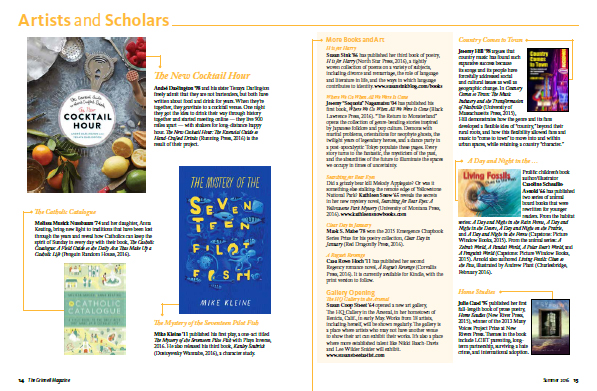
    Book Review in Grinnell Magazine

    I am pleased to have my books reviewed in the summer issue of the Grinnell Magazine on page 15. I studied art and literature at Grinnell College, Grinnell, Iowa, and graduated with a major in Art. An almost complete collection of my books can be found in the alumni section of the college library.
    Here's the announcement of my recent books in the Grinnell Magazine:

    A Day and Night in the …
    Prolific children’s book
    author/illustrator Caroline Scheaffer Arnold ’66
    has published two series of animal board books that were rewritten for younger readers. From the habitat series: A Day and Night in the Rain Forest, A Day and Night in the Desert, A Day and Night on the Prairie,and A Day and Night in the Forest (Capstone: Picture Window Books, 2015). From the animal series: A Zebra’s World, A Panda’s World, A Polar Bear’s World, and A Penguin’s World (Capstone: Picture Window Books, 2015). Arnold also authored Living Fossils: Clues to the Past, illustrated by Andrew Plant

    Note: Books in the Habitat series are available in hardback, paperback and as e-books; the new books in the  animal series are board books, adapted from my earlier series Caroline Arnold's Animals.

    Wednesday, July 20, 2016

    Living Fossils at the Los Angeles Zoo

    Zoo Scape, May-June Issue
    My book Living Fossils: Clues to the Past focuses on animals of today that closely resemble their ancestors known from fossils. Did you know that there are many plants that are living fossils too?  Ferns, cycads, ginkgo trees, and the dawn redwood are just a few examples. You can see some of these fascinating  plants at the Los Angeles Zoo and you can read about them in the May-June issue of Zoo Scape, in an article called “Living Fossils”. Zoo Scape is the member newsletter of the Los Angeles Zoo and Botanical Gardens. Here's an excerpt:
    Ferns are so common (there are more than 11,000 species worldwide) that it's easy to overlook their remarkable history, which stretches back about 400 million years. Ferns predated flowering plants and were the dominant botanical life form during the Carboniferous era 360 to 286 millions years ago when flying insects and reptiles first appeared. 
    Take a look around YOUR neighborhood. Chances are that you have some living fossils growing near where you live!
    Ferns in my front garden

    The Nautilus is a living fossil

    Wednesday, July 6, 2016

    Review of LIVING FOSSILS in Foreword Reviews, Summer 2016


    I was pleased to receive the following nice review of my book LIVING FOSSILS, CLUES TO THE PAST (Charlesbridge) in the summer 2016 issue of Foreword Reviews.
    Living Fossils is a fascinating book providing an examination of “living fossils”: plants and animals that retain characteristics of their earliest ancestors. The book discusses six different species, with beautiful, detailed illustrations of both the ancient creatures and their modern counterparts. Details on how each creature survived, and how they have or have not adapted over time, are included for each creature. A time line and a glossary of terms are included. The book is intended for ages seven to ten and will surely spark the imagination of anyone interested in prehistory.

    Wednesday, June 22, 2016

    THESE BOOKS ROCK: Review of LIVING FOSSILS by Sue Smith-Heavenrich

    The following review of my book LIVING FOSSILS, Clues to the Past by Sue Smith-Heavenrich appeared in her column, "Alexander’s Library", in the summer 2016 Ithaca Child. I can tell that the reviewer has had a lifelong fascination with fossils, just as I have!

    Sue Smith-Heavenrich writes:
    My favorite book when I was a kid was my dad’s geology text. I spent hours poring over photos of fossils, losing myself in the geological time scale, sounding out “Carboniferous” and “Silurian”. So I’m always happy when I find great books about rocks for kids.

    Living Fossils: Clues to the Past
        When you think of fossils, you might think of dinosaur bones or trilobites...something preserved in rock. Something prehistoric. Extinct. But what if some of those ancient creatures still lived among us? Would we recognize them?
        Caroline Arnold shows us six amazing creatures that closely resemble their ancient relatives–“living fossils”. Comparing “then” to “now” she shows where these creatures live, how they survived, and what their future looks like. Take, for example, horseshoe crabs. One hundred fifty million years ago, horseshoe crabs had hard shells and long tails. They crawled up on sandy beaches to search for worms and shellfish to eat. Not much has changed. If you visit the east coast on a warm summer night when the moon shines full, you’re likely to see hundreds of horseshoe crabs pull themselves up onto the beach. They’re digging nests and laying eggs, just like they did millions of years ago.
        You don’t need to travel to the beach to find living fossils; just head to a wetland or hayfield on a warm day and look for dragonflies. Those keen mosquito-devouring hunters are the great-great-great-.....great-grandchildren of dragonflies that lived 280 million years ago. Over the years things changed, like size. Back then dragonflies were larger–the size of a crow. (Charlesbridge, 2016; ages 7-10)


    The other books reviewed in the same article are:
    Explore Fossils! With 25 Great Projects by Candace L. Brown and Grace Brown (Nomad, 2016; ages 7-10)
    Ultimate Explorer Field Guide: Rocks and Minerals by Nancy Honovich (National Geographic Children’s Books, 2016; ages 7-12)
    A Rock Can Be by Laurie Purdie Salas (Millbrook Press, 2015; ages 4-7)

    This review also appears in Sue Smith-Heavenrich's June 24, 2016 blogpost at Archimedes Notebook, a terrific website that focuses on hands-on science exploration for children and their parents.

    Tuesday, February 23, 2016

    Review of LIVING FOSSILS in School Library Journal, February 2016

    I was pleased to receive this excellent review of Living Fossils: Clues to the Past in the February issue of School Library Journal.

    A glimpse into the world of living fossils, or modern-day plants or animals that are very similar to now extinct species. Realistic acrylic paintings of the different creatures and their fossilized counterparts accompany brief text describing the creatures and comparing them to their modern versions. Sidebars point to specific survival adaptations that have allowed the horseshoe crab and dragonfly to survive from their initial evolution to today, for examples. An overview time line, which covers 3.5 billion years, will help readers see the sequence of development. The volume ends with a spread that offers further details about the six species covered. VERDICT: A strong addition to all libraries and one that dinosaur fanatics will love.  Dorcas Hand, Annunciation Orthodox School, Houston, TX

    Saturday, February 13, 2016

    Review of LIVING FOSSILS in Booklist

    Title page of Living Fossils: Clues to the Past (Charlesbridge, 2016)
    I was pleased to receive this very nice review of LIVING FOSSILS: Clues to the Past in the January 1 and 15 issue of Booklist.

    The discovery of a living coelacanth, a fish previously known only from 65-million year-old fossils, leads off this introduction in “living fossils,” current animal species that researchers can study to learn about their prehistoric ancestors. Through the book, Arnold’s writing is concise, descriptive, and informative. Illustrated with large nicely composed acrylic paintings that show the creatures within their natural habitats, the text presents five additional species: the horseshoe crab, dragonfly, tuatara, chambered nautilus, and Hula painted frog. The first spread in each four-page section features the animal in prehistoric times, while the second discussed the animal as it is today. This now-and-then structure works well to tell the two-part story of each organism. Back matter includes a time line, more detailed information on species, and a note clarifying that though the ancient and modern animals may share the same name and basic appearance, they did evolve and are not identical. An intriguing look at animals, past and present, and a fine addition to the science shelves.  Carolyn Phelan, Booklist, January 1 and 15, 2016