Showing posts with label metamorphosis. Show all posts

Friday, May 21, 2021

Monarch Butterfly Eggs in My Garden

Monarch butterfly eggs on a milkweed leaf

Two days ago I saw a monarch butterfly hovering over the milkweed plants that are growing in containers on my patio. Then I saw her land on a leaf, stay for a moment, then leave. She did this several times. After she left and I turned the leaf over I saw several small white dots--monarch butterfly eggs! In a few days, they will hatch into tiny caterpillars. The caterpillars will eat the milkweed leaves and, in a few weeks, turn into butterflies--the amazing process of metamorphosis. No matter how many times I see it, it always seems miraculous.

Monarch females usually lay a single egg on a milkweed plant, often on the bottom of a leaf near the top of the plant. Eggs are only about the size of a pinhead or pencil tip and are off-white or yellow, characterized by longitudinal ridges that run from the tip to the base.

Note: Monarch butterflies are increasingly endangered because of the disappearance of the milkweed plants that the caterpillars depend on for their food. 

Monarch butterfly on a wild milkweed plant in Wisconsin


Thursday, January 10, 2019

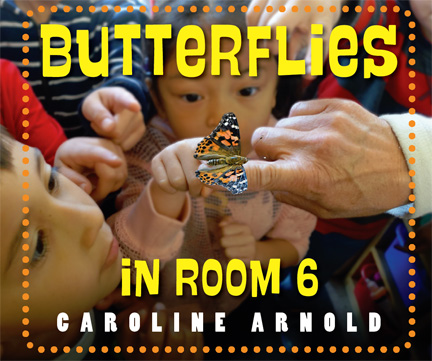
Booklist Advance Review of BUTTERFLIES IN ROOM 6

I am delighted with this very positive review of my new book, Butterflies in Room 6, published by Booklist, the journal of the American Library Association. The official publication date of the book is March 12, 2019. Look for it in your bookstore!

Butterflies in Room 6
By Caroline Arnold. Illus. by the author
Mar. 2019. 40p. Charlesbridge, $16.99 (9781580898942). PreS–Gr. 3. 638

In this attractive science book, writer and photographer Arnold presents the life cycle of a butterfly as observed in a Los Angeles kindergarten classroom. The teacher brings tiny painted lady butterfly eggs to school and places them in a box with food. As the eggs hatch, the caterpillars crawl, eat, and climb to the top of their containers, where they enter the pupal stage within chrysalises. Transferred to a large netwalled enclosure, they begin to emerge eight days later as butterflies. Outdoors, each one crawls onto a child’s finger, rests, and then flies away. Arnold comments on each step of caring for the animals, as well as each stage of their life cycle. Along the way, she provides just enough information and detail for young children who want to know more. It’s enlightening to observe the butterflies' stages of life in the clear, color photos, but it’s also a pleasure to see the children’s reactions: curiosity, caution, rapt attention, surprise, excitement, and joy. An appended page answers pertinent questions. An amiable, eye-opening introduction to metamorphosis.
— Carolyn Phelan

Wednesday, September 2, 2015

PROJECT: Butterfly Life Cycle with Pasta

A butterfly’s life cycle begins with an egg, which hatches into a caterpillar, which develops into a chrysalis and then metamorphosizes into a butterfly. You can observe all of these stages if you hatch painted lady butterflies in your classroom. And the perfect art project to illustrate the stages can be done with a paper plate and pasta.

You will need:
  • A paper plate
  • 4 types of pasta: bulgar for eggs; ziti for the caterpillars; shells for the chrysalis; and bowties for the butterflies
  • Glue
  • Markers, paint or crayons
Directions:
  • Make an “X” across the paper plate to divide it into four sections.
  • Label each section with a butterfly stage: egg, caterpillar, chrysalis, butterfly
  • Glue the appropriate pasta in each section. Draw or paint leaves. Color the pasta if desired.
I thank Jennifer Best for sharing this project with me. Her kindergarten students at Haynes Center for Enriched Studies did this project when they were learning about insects.
Painted Lady Caterpillars