Showing posts with label science. Show all posts

Wednesday, March 25, 2020

Projects for Kids: A GARDEN IN YOUR KITCHEN, Dried Beans and Peas

Sprouting a bean seed
Look around your kitchen. Some of the things we eat are seeds. Some of the things we eat have seeds in them. And some, such as pineapples and carrots, will sprout new leaves if placed in water. Now, at a time when many schools are closed, I will post a new simple gardening project each week that kids can do at home. Have fun watching things grow!

Dried Beans and Peas
There are many kinds of dried beans and peas--navy beans, lima beans, kidney beans and more. Usually, these are cooked and used in soups or hot dishes. But you can also plant them and watch them grow. Only dried beans will grow. Any bean that has been cooked will not grow.
You will need a glass jar or clear plastic cup. Line it with a piece of damp paper towel. Put beans between the towel and the glass. Fill the inside with potting soil.* Keep the dirt and towel moist and warm. In a few days you will see your beans begin to grow. The root will grow down, and the sprout will grow up. Soon leaves will develop from the sprouts. The roots grow longer each day. Measure them each day to see how fast they grow.
*You can omit the soil and still watch your bean sprout as long as you keep the towel moist.
If you plant your sprouted bean seed (paper towel included) in a pot of soil, it will grow into a leafy plant. After the bean sprout has used up the food in the seed, it uses nutrients in the soil to continue growing.
You can experiment with other seeds and plants around your house. It’s fun to discover how things grow–and you’ll end up with a beautiful garden in your kitchen!

Look for all the kitchen garden projects in these posts:
Dried beans and peas 3/25/20
Fresh Vegetable Seeds 4/1/20
Herbs and Spices 4/8/20
Birdseed 4/15/20
Citrus Fruits  4/22/20
Carrots  4/29/20
Pineapple  5/6/20
Avocados 5/13/20

Wednesday, January 8, 2020

Science Magazine Review of Butterflies in Room 6

I was pleased to get this excellent review of Butterflies in Room 6 in the December 6, 2019 issue of Science Magazine in their article, Wishlist-worthy Books for Young Readers, a list of the finalists for the AAAS/Subaru SB&F Prize for Excellence in Science Books.

Metamorphosis—of ugly ducklings into swans, of jellylike spawn into frogs, of caterpillars into butterflies—always seems miraculous. In this book on insect metamorphosis, Caroline Arnold tells the story of Mrs. Best, a kindergarten teacher who brings a tiny vial of butterfly eggs into her classroom. Her students supply a vivarium with special caterpillar food so they can watch the metamorphosis of the eggs into caterpillars, then pupae, and finally glorious adult painted ladies. The book takes the reader through the course of the children's project, with a series of fine photographs showing the details of each stage in the life cycle of the butterflies. The exciting anticipation of each transformation is summarized in carefully considered text and culminates, of course, with the day the exquisite adults emerge from the pupal case, unfurl, and stiffen their patterned wings. Beautiful close-up images let the readers examine details of the insects' anatomy and learn about butterfly biology.

Finally, a warm day arrives, and it is time to release the butterflies. The dazed insects first walk onto the children's hands before lifting off to disappear over the horizon. Fortunately, some hang around to appreciate the school garden's flowers.

It would have been good for Butterflies in Room 6 to say a little more about why insects are having such a tough time now, as well as more about their role in pollination and human food security. Still, it is an excellent book, sure to generate discussion and flights of imagination among humans who are similarly poised for big changes.
By Caroline Ash

Monday, October 28, 2019

AAAS/Subaru SB&F Prize for Excellence in Science Books

I have just learned that Butterflies in Room 6 has made it to the longlist for the 2020 AAAS/Subaru SB&F Prize for Excellence in Science Books in the Children’s Science Picture Book category! The book is one of eight books that were selected. Out of this list, the judges will chose four finalists. 
The Prize celebrates outstanding science writing and illustration for children and young adults and is meant to encourage the writing and publishing of high-quality science books for all ages. I am so pleased and honored to have my book on this list.

Wednesday, August 28, 2019

STEM LitLinks for BUTTERFLIES IN ROOM 6 at Patricia Newman's Blog

I am happy to contribute to Author/Speaker Patricia Newman's wonderful blog featuring ways to connect STEM books with literature in the classroom. My article Hands-On BUTTERFLY ACTIVITIES Reinforce Reading posted today, joining dozens of previous posts by other children's book science writers and illustrators. In my post I discuss reading strategies to use in the classroom with my book Butterflies in Room 6 along with activities that will help children understand the concepts in the book.
Thanks Patricia for the opportunity to contribute to your terrific site!

Wednesday, May 1, 2019

CELEBRATING EARTH WEEK, Author Visit at Pilgrim School, Los Angeles, CA

Author Visit at Pilgrim School, Los Angeles, CA
Last week I visited Pilgrim School in Los Angeles, California, and presented to two enthusiastic groups of children--grades K through 2, and grades 3 through 5. I was pleased with their response to my program and good questions. With both groups I shared my new book Butterflies in Room 6, and showed them my cup of caterpillars. Many of the children recalled raising butterflies from caterpillars at school when they were in earlier grades.
Kathie Shorkey, Science Teacher, with butterfly art projects

My visit was initiated by science teacher Kathie Shorkey as part of her Earth Week celebration at the school. She showed me an art project she did with the first graders. Using found objects–ranging from sticks, to buttons, to pop-tabs from drink cans–they formed the shape of a butterfly on photo paper and then exposed the paper to the sun. The paper was then developed and the shape of the butterfly was revealed against a background of blue.
With Carole Koneff, Elementary School Librarian

I thank Kathie and Elementary School Librarian Carole Koneff for inviting me to Pilgrim and making all the arrangements for my presentation and for the book sale. Carole gets the prize for the most creative author introductions. She does them for all visiting authors and this is the second one she has done for me. I love the way she has included so many of my books--and made the lines rhyme!

CAROLINE ARNOLD--PILGRIM SCHOOL 4/25/19
By Carole Koneff
160 books or more have been researched and written down.
She's traveled far and wide and is often out of town.
Dinosaurs, Global Warming, Butterflies, Chicks,
Rain Forest, Easter Island, Things in Room 6,
Taj Mahal, Desert, Eagle, Warmer World,
Many facts and figures have gradually unfurled.
Skeletal, octopus, shockers, hot, cold,
Words from many titles of books that she has sold.
Wombat, Penguin, Zebra, Kangaroo,
Just a few of the animals she's written about for you.
She's retold a famous folk tale and has a story about worms,
A book about the sniffles that surely features germs.
It's her second trip to Pilgrim and we are glad she's back
To refresh our smarts on nonfiction and keep our brains on track.

Thank you Carole!  I also thank the Upper School Librarian Kris Williams for her help with my visit. I had a nice lunch with Carole and Kris before my talks. I had a great day at Pilgrim and enjoyed it very much!

Wednesday, April 10, 2019

LITERACY NIGHT: SCIENCE EDITION at San Gabriel Avenue Elementary School, South Gate, CA

Mural at San Gabriel Avenue School Literacy Night: Science Edition
Last week on Friday, I was the guest of honor at the San Gabriel Avenue Elementary School in South Gate, California for their annual literacy night, this year focusing on science. Children and their families filled the school playground, exploring various booths with science exhibits, turning in their raffle tickets for free books, competing in the champion pinewood derby races, listening to music, and enjoying pizza and other snacks on picnic blankets and lawn chairs.
With fourth grade teacher Mr. De Santos
I had a table for my books behind the stage area where I displayed my books. As a backdrop there was a wonderful mural depicting scientists learning about caterpillars and butterflies just as the children do in my book, Butterflies in Room 6. The kindergarten classes at San Gabriel were also learning about butterflies and on another table their butterflies were on exhibit, sitting next to the incubator where they were hatching eggs. I enjoyed the chance to talk with children and their parents as they came to my table to look at and buy my books, peer through my magnifying glass, and get a closeup look at my ostrich egg.
View from my table of the crowd and DJ
At the end of the afternoon the San Gabriel Mighty Angels Dance Team performed to music and then I did a presentation, talking about my books and life as a writer. The final event was a drawing for prizes.
With teachers Lauren Cantu (left) and Cindy Taylor (right)
The whole afternoon was a wonderful celebration of literacy, with a special emphasis on science. I thank kindergarten teacher Cindia Curiel-Taylor for inviting me and the San Gabriel PTA for sponsoring my visit. Cindy did a great job of organizing and directing the activities and was helped by other teachers at the school. In the spirit of the day, all were wearing white scientific lab coats. I wore my butterfly t-shirt: "Soar into Reading with science books for kids!"

Saturday, February 16, 2019

NGSS Standards and GLOBAL WARMING AND THE DINOSAURS

The Next Generation Science Standards provide guidelines for science education from K-12. Based on a report produced by the National Research Council they call for a new approach to teaching science.
Books like mine can be used in support of achieving these standards, especially in Life Science (LS) and Earth and Space Science (ESS).

Global Warming and the Dinosaurs by Caroline Arnold (Clarion, 2009)
NGSS Standards for grades 3, 4 and 5:
3-LS4-2. Use evidence to construct an explanation for how the variations in characteristics among individuals of the same species may provide advantages in surviving, finding mates, and reproducing.
4-LS1-1. Construct an argument that plants and animals have internal and external structures that function to support survival, growth, behavior, and reproduction.
4-LS1-2. Use a model to describe that animals receive different types of information through their senses, process the information in their brain, and respond to the information in different ways.
4-ESS1-1. Identify evidence from patterns in rock formations and fossils in rock layers to support an explanation for changes in a landscape over time.
4-ESS2-2. Analyze and interpret data from maps to describe patterns of Earth’s features.
5-ESS2-1. Develop a model using an example to describe ways the geosphere, biosphere, hydrosphere, and/or atmosphere interact.


Saturday, January 26, 2019

NGSS Standards and A DAY AND NIGHT IN THE RAIN FOREST

The Next Generation Science Standards provide guidelines for science education from K-12. Based on a report produced by the National Research Council they call for a new approach to teaching science. Books like mine can be used in support of achieving these standards, especially in Life Science (LS) and Earth and Space Science (ESS).

A Day and Night in the Rain Forest by Caroline Arnold (PictureWindow Books, 2015)
A Day and Night in the Desert by Caroline Arnold (PictureWindow Books, 2015)
A Day and Night in the Forest by Caroline Arnold (PictureWindow Books, 2015)
A Day and Night on the Prairie by Caroline Arnold (PictureWindow Books, 2015)
NGSS Standards for grades 2, 3 and 4:
2-LS4-1. Make observations of plants and animals to compare the diversity of life in different habitats.
3-LS2-1. Construct an argument that some animals form groups that help members survive.
3–LS2-3. Construct an argument with evidence that in a particular habitat some organisms can survive well, some survive less well, and some cannot survive at all.
4-LS1-1. Construct an argument that plants and animals have internal and external structures that function to support survival, growth, behavior, and reproduction.

Saturday, January 19, 2019

NGSS Standards and TOO HOT? TOO COLD? KEEPING BODY TEMPERATURE JUST RIGHT

The Next Generation Science Standards provide guidelines for science education from K-12. Based on a report produced by the National Research Council they call for a new approach to teaching science.
Books like mine can be used in support of achieving these standards, especially in Life Science (LS) and Earth and Space Science (ESS).

Too Hot? Too Cold? Keeping Body Temperature Just Right By Caroline Arnold (Charlesbridge, 2013)
NGSS Standards for grades 3 and 4:
3-LS4-2. Use evidence to construct an explanation for how the variations in characteristics among individuals of the same species may provide advantages in surviving, finding mates, and reproducing.
4-LS1-1. Construct an argument that plants and animals have internal and external structures that function to support survival, growth, behavior, and reproduction.
4-LS1-2. Use a model to describe that animals receive different types of information through their senses, process the information in their brain, and respond to the information in different ways.

Wednesday, March 14, 2018

SCIENCE PROJECT LAYER CAKE--History of the Earth

My grandson Lucas made an amazing edible work of art for his 8th grade science project - check out the orange skittles fossils, different sedimentary layers, and the volcano with chocolate lava! Also impressive are the informative labels. Thanks, Lucas, for allowing me to share it!
 It turns out you can buy sugar paper and sugar pens! Very handy when your cake requires informative labels.
 Lucas' cake is a definite step up from one of my favorite classroom projects--peanut butter and jelly geology done some years ago at a school I visited. The jelly are the tar pits and pretzels are the fossil bones.

Wednesday, May 31, 2017

GREAT SCIENCE BOOKS FOR KIDS


I was pleased to be included in a wonderful list of great science books for kids put together at the blogsite GeekWrapped. On the list of 100 titles is my book Too Hot? Too Cold? Keeping Body Temperature Just Right (Charlesbridge, 2013).  In it readers will discover the remarkable--and similar--ways in which humans and animals adapt to heat and cold. The book is illustrated with lovely watercolor paintings by Annie Patterson.


Wednesday, January 25, 2017

PUBLICATION PARTY AT HAYNES SCHOOL for Hatching Chicks in Room 6


Lollipops to Celebrate the Publication of Hatching Chicks in Room 6

Last Thursday I made a special visit to Haynes CES School to present my new book, Hatching Chicks in Room 6, to the school, and to celebrate its publication with Jennifer Best, her students who are in the book, and their families. The party was after school in her room, but earlier in the day I gave two assemblies in the auditorium to all grades where I presented the book and talked about the process of writing it. Even for students who didn't have Mrs. Best for kindergarten (she is one of three kindergarten teachers in the school) there was school-wide excitement about the book.

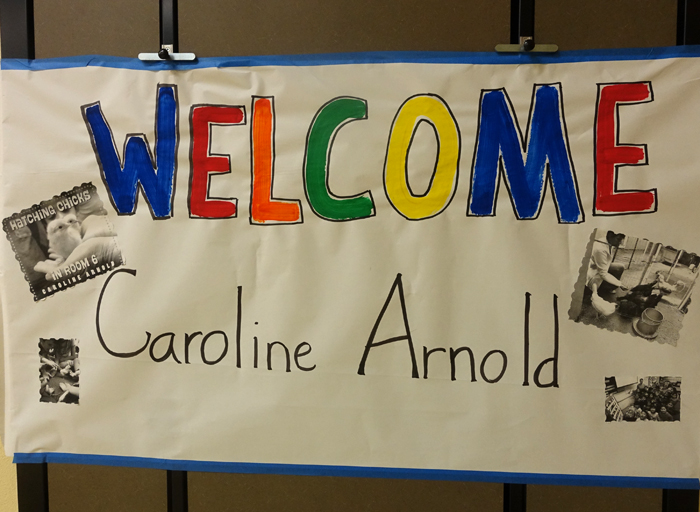
Welcome Banner in Auditorium
Mrs. Best hatches chicks every year. During the incubation and hatching process many students in other classes drop by her room to see the eggs and chicks and check their progress. During the assembly I gave a book to Mrs. Meade, the principal, who was very supportive of the project and will feature it at a district meeting in. March. I also donated a book to the school library.

Caroline, Mrs. Best, and students with their new books
The party began with a presentation of an autographed book to each child. I

also gave each child a postcard and a chick lollipop--they could choose a
yellow, pink, or blue chick. To my surprise, the pink and blue chicks were
just as popular as the yellow ones. (I ordered the lollipops on the
internet.)
Chick cupcakes to celebrate
After the presentation and photographs it was time to eat. I
provided cupcakes decorated to look like chicks. (I bought the candy eyes
and beaks at a local cake decorating shop.) We also had some healthier
food--fruit, cheese, crackers and veggie sticks--and by the end of the party
all the food was completely gone. 

Mrs. Best sharing the book with some of her students
The children who are in the book are now in second grade. You can see in the
photos how much they have grown! They were thrilled to get the books and so
were their parents. Almost all the children who are in the book came to the party, even
several who had moved to other schools.

I am excited about promoting this book and pleased with all the good
reviews. I noticed on Amazon that it is number one in Hot New Releases
for Children's Science Experiment Books.
I thank Jennifer Best, her kindergarten students of 2014-15, their families, and everyone at Charlesbridge for helping to make this a great book!

Wednesday, July 27, 2016

NYPL Recommends: New Nonfiction for Kids

I was delighted to discover my new book, LIVING FOSSILS: Clues to the Past on the list of books recommended by the staff of the New York Public Library, in a blog post NYPL Recommends: New Nonfiction for Kids written by Lynn Lobash, Manager of Reader Services.  In each of six categories–science, biographies, sports, animals, art and other stuff–the library's Best Books for Kids committee has chosen several books.  In addition to my book in the science category, the other two titles are: Solving the Puzzle Under the Sea: Marie Tharp Maps the Ocean Floor by Robert Burleigh [Gr. 2 - 4]A beautifully illustrated biography about the first person to successfully map the ocean floor.
and
Professor Astro Cat’s Atomic Adventure: A Journey Through Physics by Dr. Dominic Walliman & Ben Newman [Gr. 2 - 5]A cat explains physics and finally I get it!
These and all of the other books recommended by NYPL look equally fascinating.
I am proud that Living Fossils is included in this list!

Saturday, April 18, 2015

THE EARTH IS OUR HOME: Celebrating Science with Children and Families at the Los Angeles Public Library

In the Children's Literature Room at the Los Angeles Public Library
On April 3rd  I was a guest speaker at the Saturday Family Program in the Children’s Literature Department at the Los Angeles Public Library in downtown Los Angeles. It was a fun afternoon with a lively group of children and their parents. We met in the Story Theater. April is Science Month and Earth Day so the focus of the program was on protecting the Earth. Librarians Mara Alpert and Linda Israelson began the program with three songs–This Land is Your Land, E-A-R-T-H (to the tune of Bingo) and This Old Earth, and reading two picture books–The Earth Book by Todd Parr and The Earth and I by Frank Asch. Then I gave a presentation about my books, focusing on animals and how worms help the garden grow. I read my book Wiggle and Waggle and at the end of the hour, the participants took home some Wiggle and Waggle activity sheets. I thank FOCAL (Friends of Children and Libraries) for sponsoring my participation. Throughout the year FOCAL will sponsor more author visits to the Central Library Saturday programs.

Wednesday, December 4, 2013

Too Hot? Too Cold? OUTSTANDING SCIENCE TRADE BOOK

I was thrilled to learn that my book, Too Hot? Too Cold? is on the recently announced NSTA (National Science Teachers Association) Outstanding Science Trade Books K-12, 2014.  The list of winning titles is now available on the web and will be published with fully annotated reviews in the March 2014 issue of NSTA’s K-12 journals.  Here’s what NSTA says about the list:

This year, science teachers and mentors have been challenged to meet the high expectations of the Framework for K–12 Science Education and the Next Generation Science Standards. The Framework urges us to help learners “[build] progressively more sophisticated explanations of natural phenomena…” while NGSS provides a model for “gathering, describing, and using information about the natural and designed world(s).” In the development of curricula that meet these challenges, literature is an essential partner. “The NGSS are aligned with the CCSS [Common Core State Standards] to ensure a symbiotic pace of learning in all content areas.”

Wednesday, June 19, 2013

The Science of Apple Pie: Cooking as a Science Project

Is baking an apple pie a science experiment? Why not? The multiple variables--type of apple, moisture, fat content, spices, salt, etc. all impact the final result and can be measured and charted. Recently I attended the UCLA Science of Pie lecture by Chefs Christina Tosi of Momofuku Milk Bar in NYC (who brought compost cookies) and Zoe Nathan of the Rustic Canyon restaurant group (she had samples of her blueberry cornmeal cake) who shared some of their baking secrets and also were part of a panel to judge the student made pies at booths around the room.  The pies were projects of students in the Science and Food class.  You can read more about the event in this terrific article in the LA Times.

Each group of students had experimented with different variables. Then they made a poster presentation of their project. We all got to sample the pies. My favorite--an apple sour cream pie with a crunchy crust!
You can find out more about the activities of the science and food class and the public lecture series at their blog scienceandfood --Promoting knowledge of science through food, and food through science.

Science note:  Understanding food molecules can help us to enhance the desired flavors and textures in our food.  Apples contain pectin molecules.  By intereacting to form a network, these molecules can provide texture for pie fillings, jams, and gumdrops!

Wednesday, December 5, 2012

A WARMER WORLD, NSTA Outstanding Science Trade Book

I was delighted to learn that A Warmer World is on the National Science Teachers Association Outstanding Science Trade Books for Students K-12 for 2013.  It is an honor to be on this select list and a reward for all the hard work by my editors and everyone at Charlesbridge.  Thank you!

The OSTB list now includes a wider range of books than ever before.  NSTA says: "Our vision of what we call science has broadened. The practices we use to explore the natural world and to create new products now include mathematics and engineering. We also recognize the importance of the arts, history, and human perspectives in these explorations. Science is not just one “way of knowing,” but many."

Here is a link to the list and the entry for A Warmer World:
A Warmer World. Caroline Arnold. Charlesbridge.
Beautiful book with two levels: story line and facts about an important current issue and its effect on animals.