Showing posts with label Patricia Newman. Show all posts

Wednesday, April 17, 2024

LITLINKS GUEST POST: Our Warming Earth, Sea Ice and Krill

Lit Links: An Easy Way to Find Out How Baleen Whales Eat

This week at LitLinks you can find my article about how you can use my book A WARMER WORLD in connection with reading and STEAM activities. I am happy to contribute to Author/Speaker Patricia Newman's wonderful blog featuring ways to connect STEM and STEAM books with literature in the classroom. My article features hands-on activities and reading strategies for using my book with students, helping them understand the concepts in the book. It posted on April 17, 2024 , joining dozens of previous posts by other children's book science writers and illustrators.

Many thanks, Patricia, for the opportunity to contribute to your terrific site!


Wednesday, August 31, 2022

LITLINKS GUEST POST: Watching the Weather and Keeping a Log


What would it be like to be a lighthouse keeper--as a woman, alone, on an island in San Francisco Bay?


This week at LitLinks you can find my article about how you can use my new book KEEPER OF THE LIGHT: Juliet Fish Nichols Fights the San Francisco Fog in connection with reading and STEAM activities. I am happy to contribute to Author/Speaker Patricia Newman's wonderful blog featuring ways to connect STEM and STEAM books with literature in the classroom. My article features hands-on activities and reading strategies for using my book with students, helping them understand the concepts in the book. It posted on August 31, 2022 , joining dozens of previous posts by other children's book science writers and illustrators.

Many thanks, Patricia, for the opportunity to contribute to your terrific site!

Wednesday, March 30, 2022

THE PLANT CYCLE: Foldable Project Teaches the Plant Growth Cycle, by Debbie Gonzales at LitLinks

Project by Debbie Gonzales at LitLinks
I discovered this easy foldable project by guest blogger Debbie Gonzales at LitLinks (Patricia Newman's blog linking literature and STEM.) It is perfect to use in conjunction with my new book PLANTING A GARDEN IN ROOM 6: From Seeds to Salad. It introduces children to the stages of plant growth from seed to maturity in a simple folding paper project. https://www.patriciamnewman.com/litlinks-easy-foldable-activity-to-illustrate-the-plant-cycle/

Debbie's project was created for the new book  NIGHT BECOMES DAY: CHANGES IN NATURE, written by Cynthia Argentine . 


Wednesday, March 23, 2022

GUEST POST AT LITLINKS: Plant a Garden, Grow a Reader!

Guest post at Lit Links, March 16, 2022

How does a school garden sprout young readers? Find out in 4 easy lessons! This week at LitLinks you can find my article about how you can use my new book Planting a Garden in Room 6: From Seeds to Salad in connection with reading and STEAM activities. I am happy to contribute to Author/Speaker Patricia Newman's wonderful blog featuring ways to connect STEM and STEAM books with literature in the classroom. My article features hands-on activities and reading strategies for using my book with students, helping them understand the concepts in the book. It posted on March 16, joining dozens of previous posts by other children's book science writers and illustrators.

Many thanks, Patricia, for the opportunity to contribute to your terrific site!

Saturday, October 10, 2020

LITLINKS GUEST POST: Kids See Chicks Hatch With Their Own Eyes

This article first appeared on September 16, 2020, as a guest post at Patricia Newman's blog, LitLinks, Authors, Educators, Scientists sharing the natural connections between STEM and Language Arts. 


Life Cycle Reinforces Reading:

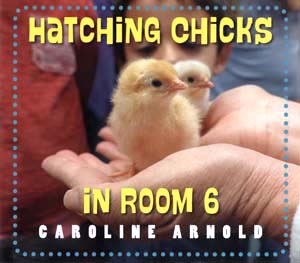
In 21 days, chicks will hatch in Room 6! A hen laid the eggs, and Mrs. Best brought them to school and put them in an incubator. Soon the chicks will PECK, PUSH, and POP right out of their shells. The kindergarteners are counting down to hatching day. When it happens, they’ll be ready.
Among the many lessons learned in HATCHING CHICKS IN ROOM 6 is the life cycle process–from incubating the eggs, seeing the shells break open, to watching the chicks grow from fluffy balls to fully feathered chickens. It is one thing to be told that chicks grow in eggs, but another to actually see an egg hatch with your own eyes. This photo essay follows an egg from the time it is laid in the henhouse, through the incubating and hatching process in a school classroom, to the time when the chicks are ready to go back to the flock. Children observe the eggs and chicks up close as they learn firsthand about a chicken’s life cycle.

Strategies for reading Hatching Chicks in Room 6:


Main text: The text of HATCHING CHICKS IN ROOM 6 is written on two levels—the main narrative, printed in larger type, and sidebars, printed in smaller type. Headings are red and in capital letters for emphasis. What is the effect of telling the story in the present tense? Does it make you feel as if you are participating in the process?
Sidebars and captions: The sidebars and captions add information, provide the opportunity to introduce more difficult vocabulary, and expand on material in the main text. Note that the sidebars are printed over a photo of an egg, reinforcing the theme of the book.
Photos: “Reading” the photos is an important part of understanding the book. Photos:
  • Add information to the story (such as showing what an incubator looks like),
  • Show the children in their environment (in the classroom and outside in the chicken pen),
  • Provide a sense of scale (we see the size of a newly hatched chick as it rests in a child’s hand), and
  • Enlarge details for a closer look (the parts of a chick’s body).
  • The photos also reveal the children’s emotional response to the chicks. We see and share their sense of wonder as they participate in each step of the process.
Back matter:  Back matter includes answers to questions about eggs and chicks, vocabulary, links to online information about hatching chicks, and a list of books for further reading.

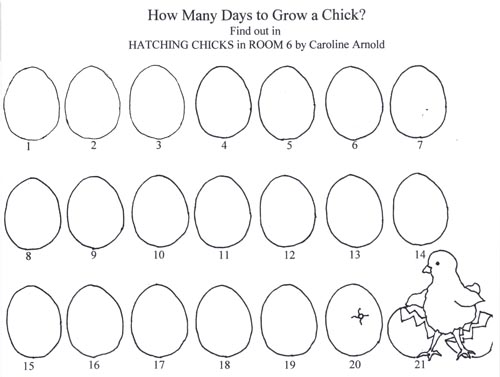
Hands-on: How many days to hatch a chick?

The events of the story in HATCHING CHICKS IN ROOM 6 occur in chronological order. You can use these events to create a time line, beginning with the day the eggs go into the incubator.  Click HERE for a downloadable coloring page.

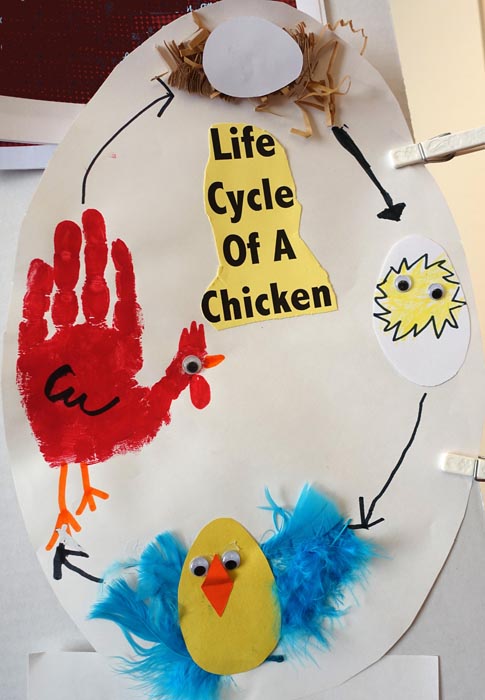
Which came first, the chicken or the egg?

In one classroom of second graders, the children made a mixed media presentation to show the life cycle of a chicken. They used packing material to represent the chicken’s nest, real feathers to represent the growing chick, a hand-print for the body of an adult chicken, markers for drawing, and googly eyes for all. Mounted on a large poster board cut into an egg shape, with black arrows drawn to indicate the circular process, it is a dramatic and colorful presentation.

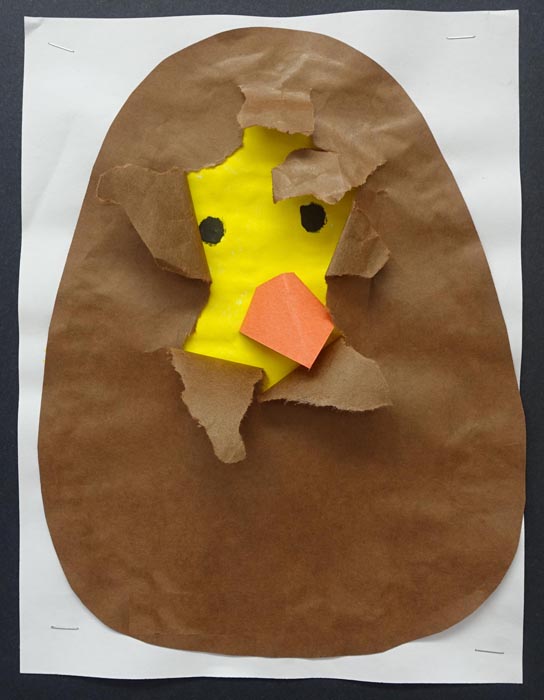
Ready to hatch!

When a chick is ready to hatch, it uses its beak to poke a hole in the shell.
For this project you will need: Construction paper, pencil, scissors, glue, black marker.
1. Cut out two large egg shapes from yellow and brown paper. Cut a small hole in the middle of the brown paper. Glue the egg shapes together around the edges.
2. Carefully tear back the hole in the brown paper, pulling the pieces to reveal the yellow paper underneath.
3. Use a marker to draw two black eyes. Cut a triangle of orange paper and fold in half to make a beak. Glue it on.
Now your chick looks like it is ready to hatch!

Caroline Arnold has been writing since 1980 and is the author of 170 books for children, including  Butterflies in Room 6 (2019) and companion book Hatching Chicks in Room 6 (2017), a JLG Premier Selection and CRA Eureka Award winner. She illustrated both books with her own color photos. Other recent titles include A Day and Night in the Rain Forest in her Habitats series, illustrated with her own cut paper art. A noted science writer, Caroline Arnold has had thirty-three books on the NSTA Outstanding Science Trade Books list including Too Hot? Too Cold? and  A Warmer World. Her books are inspired by her travels, her love of animals, fossils, and the out-of-doors. She lives in Los Angeles, California. www.carolinearnold.com

Wednesday, September 16, 2020

LITLINKS: Kids See Chicks Hatch with their Own Eyes, Guest Post at Patricia Newman's Blog

This week at LitLinks: Kids See Chicks Hatch with Their Own Eyes you can find my article about how you can use my book Hatching Chicks in Room 6 in connection with reading and STEAM activities. I am happy to contribute to Author/Speaker Patricia Newman's wonderful blog featuring ways to connect STEM and STEAM books with literature in the classroom. My article features hands-on activities about chickens and eggs and reading strategies for using my book with students, helping them understand the concepts in the book. It posted today, joining dozens of previous posts by other children's book science writers and illustrators.
Thanks Patricia for the opportunity to contribute to your terrific site!

Wednesday, August 28, 2019

STEM LitLinks for BUTTERFLIES IN ROOM 6 at Patricia Newman's Blog

I am happy to contribute to Author/Speaker Patricia Newman's wonderful blog featuring ways to connect STEM books with literature in the classroom. My article Hands-On BUTTERFLY ACTIVITIES Reinforce Reading posted today, joining dozens of previous posts by other children's book science writers and illustrators. In my post I discuss reading strategies to use in the classroom with my book Butterflies in Room 6 along with activities that will help children understand the concepts in the book.
Thanks Patricia for the opportunity to contribute to your terrific site!