At the recent LAPL Mobile Museum Fair held on January 13, more than twenty Los Angeles area small museums (and a few large ones with mobile exhibits) visited the Central Library in downtown Los Angeles.
One of my favorite exhibits was the International Printing Museum, where visitors were invited to make a book by folding handed out sheets first "like a taco" and then in half and half again to create a tiny Franklin's Gazette. The catch is how to cut the pages after they have been folded and then sew the binding. The man giving the talk showed how it can be done with an ordinary paper cutter and a device (something like a long stapler) when making a homemade book. Of course, when manufacturing large numbers of books, this is done in big machines.
I sometimes do a similar hands-on project with kids (using plain paper) in my author talks. After the paper has been folded and numbered, the kids can take their tiny book home and write their own story.
Among the quotes inside the tiny Franklin book is this: If you would not be forgotten as soon as you are dead and rotten, either write things worth reading or do things worth the writing.
Good advice for everybody, writer or not!
Wednesday, January 23, 2019
Saturday, January 19, 2019
NGSS Standards and TOO HOT? TOO COLD? KEEPING BODY TEMPERATURE JUST RIGHT
The Next Generation Science Standards
provide guidelines for science education from K-12. Based on a report
produced by the National Research Council they call for a new approach
to teaching science.
Books like mine can be used in support of achieving these standards, especially in Life Science (LS) and Earth and Space Science (ESS).
Too Hot? Too Cold? Keeping Body Temperature Just Right By Caroline Arnold (Charlesbridge, 2013)
NGSS Standards for grades 3 and 4:
3-LS4-2. Use evidence to construct an explanation for how the variations in characteristics among individuals of the same species may provide advantages in surviving, finding mates, and reproducing.
4-LS1-1. Construct an argument that plants and animals have internal and external structures that function to support survival, growth, behavior, and reproduction.
4-LS1-2. Use a model to describe that animals receive different types of information through their senses, process the information in their brain, and respond to the information in different ways.
Books like mine can be used in support of achieving these standards, especially in Life Science (LS) and Earth and Space Science (ESS).
Too Hot? Too Cold? Keeping Body Temperature Just Right By Caroline Arnold (Charlesbridge, 2013)
NGSS Standards for grades 3 and 4:
3-LS4-2. Use evidence to construct an explanation for how the variations in characteristics among individuals of the same species may provide advantages in surviving, finding mates, and reproducing.
4-LS1-1. Construct an argument that plants and animals have internal and external structures that function to support survival, growth, behavior, and reproduction.
4-LS1-2. Use a model to describe that animals receive different types of information through their senses, process the information in their brain, and respond to the information in different ways.
Labels:
Annie Patterson,
body temperature,
illustrator,
K-12,
NGSS,
science,
standards,
Too Hot? Too Cold?
Tuesday, January 15, 2019
KIRKUS REVIEW of Butterflies in Room 6
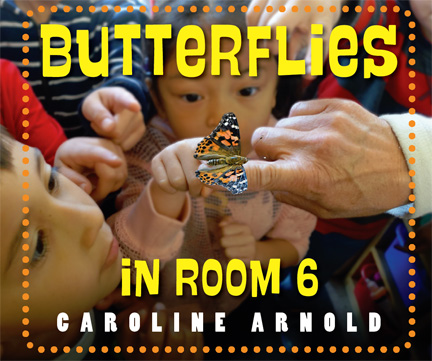
I am pleased to have another good review of my new book, Butterflies in Room 6, this time in Kirkus Reviews.
BUTTERFLIES IN ROOM 6: See How They Grow
Author: Caroline Arnold
Photographer: Caroline Arnold
Review Issue Date: February 1, 2019
Online Publish Date: January 15, 2019
Publisher:Charlesbridge
Pages: 40
Price ( Hardcover ): $16.99
Publication Date: March 12, 2019
ISBN ( Hardcover ): 978-1-58089-894-2
Category: Informational
Arnold revisits Mrs. Best's elementary classroom (Hatching Chicks in Room 6, 2017) for this look at the life cycle of the painted lady butterfly. Arnold uses the class's study of butterflies to present readers with solid facts about these insects in both the main text and leaf-shaped fact boxes. Mrs. Best's butterfly eggs come in a tube (she must have purchased them, though this is not addressed). The entire life cycle is both pictured and described in the next spread. The close-ups of the eggs in their different stages of hatching are sure to fascinate. On release day, each child gets to hold a butterfly that has crawled onto their hand. Though this book focuses on butterflies in a classroom, families could easily use this information to safely raise butterflies at home (several tips are given about keeping the insects alive and free from injury). The back matter includes a page of answered questions about butterflies, a glossary, and a list of both online and text resources for finding further information. Arnold's photos are a highlight, combining candid shots of the diverse students and their white teacher with pics of the insects, both in captivity and in nature. Labeled close-ups bring readers into the classroom and teach butterfly anatomy. A solid look at the butterfly life cycle that will have students asking their own teachers to host caterpillars in their classrooms. (Informational picture book. 4-9)
BUTTERFLIES IN ROOM 6: See How They Grow
Author: Caroline Arnold
Photographer: Caroline Arnold
Review Issue Date: February 1, 2019
Online Publish Date: January 15, 2019
Publisher:Charlesbridge
Pages: 40
Price ( Hardcover ): $16.99
Publication Date: March 12, 2019
ISBN ( Hardcover ): 978-1-58089-894-2
Category: Informational
Arnold revisits Mrs. Best's elementary classroom (Hatching Chicks in Room 6, 2017) for this look at the life cycle of the painted lady butterfly. Arnold uses the class's study of butterflies to present readers with solid facts about these insects in both the main text and leaf-shaped fact boxes. Mrs. Best's butterfly eggs come in a tube (she must have purchased them, though this is not addressed). The entire life cycle is both pictured and described in the next spread. The close-ups of the eggs in their different stages of hatching are sure to fascinate. On release day, each child gets to hold a butterfly that has crawled onto their hand. Though this book focuses on butterflies in a classroom, families could easily use this information to safely raise butterflies at home (several tips are given about keeping the insects alive and free from injury). The back matter includes a page of answered questions about butterflies, a glossary, and a list of both online and text resources for finding further information. Arnold's photos are a highlight, combining candid shots of the diverse students and their white teacher with pics of the insects, both in captivity and in nature. Labeled close-ups bring readers into the classroom and teach butterfly anatomy. A solid look at the butterfly life cycle that will have students asking their own teachers to host caterpillars in their classrooms. (Informational picture book. 4-9)
Thursday, January 10, 2019
Booklist Advance Review of BUTTERFLIES IN ROOM 6
I am delighted with this very positive review of my new book, Butterflies in Room 6, published by Booklist, the journal of the American Library Association. The official publication date of the book is March 12, 2019. Look for it in your bookstore!
Butterflies in Room 6
By Caroline Arnold. Illus. by the author
Mar. 2019. 40p. Charlesbridge, $16.99 (9781580898942). PreS–Gr. 3. 638
In this attractive science book, writer and photographer Arnold presents the life cycle of a butterfly as observed in a Los Angeles kindergarten classroom. The teacher brings tiny painted lady butterfly eggs to school and places them in a box with food. As the eggs hatch, the caterpillars crawl, eat, and climb to the top of their containers, where they enter the pupal stage within chrysalises. Transferred to a large netwalled enclosure, they begin to emerge eight days later as butterflies. Outdoors, each one crawls onto a child’s finger, rests, and then flies away. Arnold comments on each step of caring for the animals, as well as each stage of their life cycle. Along the way, she provides just enough information and detail for young children who want to know more. It’s enlightening to observe the butterflies' stages of life in the clear, color photos, but it’s also a pleasure to see the children’s reactions: curiosity, caution, rapt attention, surprise, excitement, and joy. An appended page answers pertinent questions. An amiable, eye-opening introduction to metamorphosis.
— Carolyn Phelan
Butterflies in Room 6
By Caroline Arnold. Illus. by the author
Mar. 2019. 40p. Charlesbridge, $16.99 (9781580898942). PreS–Gr. 3. 638
In this attractive science book, writer and photographer Arnold presents the life cycle of a butterfly as observed in a Los Angeles kindergarten classroom. The teacher brings tiny painted lady butterfly eggs to school and places them in a box with food. As the eggs hatch, the caterpillars crawl, eat, and climb to the top of their containers, where they enter the pupal stage within chrysalises. Transferred to a large netwalled enclosure, they begin to emerge eight days later as butterflies. Outdoors, each one crawls onto a child’s finger, rests, and then flies away. Arnold comments on each step of caring for the animals, as well as each stage of their life cycle. Along the way, she provides just enough information and detail for young children who want to know more. It’s enlightening to observe the butterflies' stages of life in the clear, color photos, but it’s also a pleasure to see the children’s reactions: curiosity, caution, rapt attention, surprise, excitement, and joy. An appended page answers pertinent questions. An amiable, eye-opening introduction to metamorphosis.
— Carolyn Phelan
Wednesday, January 9, 2019
THE PUZZLE OF BOOKS: How Writing a Book is Like Solving a Crossword Puzzle
Crossword puzzle creators are people who constantly play with words, assembling them into lists of potential theme clues, e.g. common phrases whose meaning changes with the addition or subtraction of a letter; famous names that can be turned into puns; switched word orders, and so on. When one of these lists gets long enough, they start making a puzzle.
In the same way, I collect piles of information as I research a book. Some of that information never gets used. It may be off topic, for another age group, or it just may not fit. Some of it may get saved for another book. But when I think I have enough for my project, I take what I have and sort it into its various topics or chapters. My next step is always an outline. I plan my book page spread by page spread. This provides me with the overall structure of my book, but nothing is ever set in stone. As I work, the details of the plan may change, and I may rearrange parts if it makes sense to do so.
One thing I like about crossword puzzles is the symmetry of the grids. The puzzle has to have a balanced overall pattern made by the black and white squares. Typically, one half of the puzzle is a mirror image of the other. One of the challenges in creating theme answers must be finding pairs that have an equal number of letters so that they can be placed opposite one another on the grid. In the same way, the structure of a book has to be balanced. It doesn’t have to be exactly symmetrical, but it needs to feel as if each part has relatively equal weight. And just as there are many grids for the puzzle creator to choose from depending on the requirements of the theme answers, the structure of a book can take many forms as well.
In solving crossword puzzles, everyone has their own technique. I start in the upper left and work my way to the lower right. One of my friends answers all the theme clues first and then fills in the other squares. I would like to do this, but generally I need a few hints, so I wait until I’ve filled in enough squares with the regular clues to figure out the key to the week’s theme. The puzzle title sometimes helps, usually involving another level of word play.
When I write my books, I work like my friend, and start with the main themes and gradually add the smaller details. Just like solving a puzzle, the completion of the manuscript goes bit by bit, with periods when I surge forward, and other periods when I sit stumped, until I suddenly I see how a missing piece pulls everything together.
I am sometimes asked when I do author visits at schools, “What is your favorite part of the writing process?” My answer is always the same. My favorite part of the writing process is when I am finished. Just as I breathe that sigh of satisfaction as I fill in the last square of a crossword puzzle, I have that same sense of accomplishment when the last word is written in the manuscript. Then I know that everything is in its proper place and, hopefully, will cause my readers to say “Aha! I’ve learned something new.”
This article was originally published in the Summer 2008 issue of the SCBWI/LA Kite Tales magazine.
Wednesday, January 2, 2019
SCIENTIFIC ILLUSTRATION IN THE 19TH CENTURY: The Animal Kingdom Illustrated by S.G. Goodrich
I love this drawing by S.G. Goodrich for the preface of his book, The
Animal Kingdom Illustrated, published in 1867. The elephant doesn't look
too thrilled about having his portrait painted! But perhaps S.G. Goodrich identified more with the owl as he worked to accurately portray the animal subjects of the book.
The rest of the 1400 drawings in the book are serious scientific illustrations, providing an exhaustive look at what was known about the animal world at that time. I came across the drawings in a box of old books when I cleaned out my attic. In the days before photographs, drawings like these were the only way that people learned about exotic animals except for those that they saw in zoos.
Labels:
animals,
illustration,
S.G. Goodrich,
scientific
Tuesday, January 1, 2019
HAPPY NEW YEAR!
Every New Year’s Eve in Taiwan, Taipei 101, the tallest building in the country (and until recently the tallest in the world) is the center of an impressive fireworks display. When we were in Taipei in October, we went to the top for the view. As a souvenir we had our photo taken with a picture of the tower and the New Year's fireworks in the background.
Now it is the beginning of a new year. Wherever you celebrate I wish you a very
HAPPY NEW YEAR 2019!
Now it is the beginning of a new year. Wherever you celebrate I wish you a very
HAPPY NEW YEAR 2019!
Subscribe to:
Posts (Atom)