Showing posts with label dinosaurs. Show all posts

Sunday, July 6, 2025

PTEROSAURS, Winged Reptiles of the Dinosaur Age: A Visit with Eudimorphodon in Bergamo, Italy

Caroline at the Eudimorphodon exhibit at the Natural History Museum, Bergamo, Italy.

In 2003, when I was researching my book PTEROSAURS: Rulers of the Skies in the Dinosaur Age, I visited the Natural History Museum in Bergamo, Italy, to learn more about Eudimorphodon, the pterosaur whose fossil skeleton had been found in the mountains nearby. (See my post of Feb 24, 2014 about that visit.) 


In early June this year I returned to Bergamo and the museum to get another look at Eudimorphodon and the rest of the exhibits.


The fossil skeleton of Eudomorphodon is remarkably complete.


What I especially like about the exhibit is the diorama depicting a model of Eudimorphodon in flight, demonstrating how it likely caught fish that were its main food. (Fossil scales and fish bones within the skeleton reveal Eudimorphodon’s diet.)

Going back to the museum was like meeting an old friend. PTEROSAURS: Rulers of the Skies in the Dinosaur Age was published in 2004 by Clarion Books. It is still available on Amazon as an e-book and as an audio book. Or, you can look for it in your library.

Monday, June 9, 2025

LISTEN TO RECORDINGS OF MY BOOKS ON AUDIBLE: Dinosaurs, Pterosaurs, Skeletons


I just discovered that several of my books are available to listen to at Audible on Amazon. If you like to listen to books while you are jogging, working in the garden, or riding in the car, then this is for you. You have to sign into and buy the subscription to the Audible program, but there are many books available, some of them free. The quality of the reading (different readers for each book) is excellent. You can try out samples HERE. So far, the following titles of my books are available on Audible:


Pterosaurs:Rulers of the Skies in the Dinosaur Age

You Skeletal System

Dinosaurs with Feathers: Ancestors of Modern Birds


Saturday, June 3, 2023

MEETING A GIANT OF THE DINOSAUR AGE (Via Its Fossil Remains)


Giant Sea Reptiles of the Dinosaur Age. At the Royal Tyrell Museum, Drumheller, Alberta

I love learning about dinosaurs and the world as it was when they were alive. My book, Giant Sea Reptiles of the Dinosaur Age (Clarion Books, 2007) looks at the diversity of large reptiles that once inhabited the world’s oceans. Like the dinosaurs, they all became extinct 65 million years ago. We know about them today from their fossil remains.

Opening pages of Giant Sea Reptiles of the Dinosaur Age

On my recent trip to the Royal Tyrell Museum in Drumheller, Alberta, Canada I was thrilled to see up close the remains of Shonisaurus sikanniensis, the huge ichthyosaur that I wrote about in the opening pages of the book. It is huge, filling an entire room at the museum. Here's what I wrote:

Fossil skeleton of Shonisaurus sikanniensis.

Two hundred and twenty million years ago, in waters that covered what is now western Canada, a huge marine reptile cruised the shallow seas. Propelling itself with flat, flipper-like limbs, the 70-foot long animal hunted for shellfish and other small ocean animals, which it sucked into its long, toothless snout and swallowed. This fearsome creature was Shonisaurus sikanniensis, a species of ichthyosaur, one of several types of large sea reptiles that inhabited the world’s oceans in the Dinosaur Age.

The fossil remains of Shonisaurus sikanniensis were first discovered in 1991 when a hiker in northern British Columbia spotted some big fossil bones eroding out of the banks of the Sikanni Chief River. He reported his find to the Royal Tyrell Museum of Paleontology, in Drumheller, Alberta, where one of the curators, Dr. Elizabeth Nicholls, was an expert on prehistoric sea reptiles. She visited the site and was amazed by what she saw. The bones were bigger than those of any known marine reptile, and, incredibly, most of the skeleton was intact. The only missing parts were the hind limbs. Over the course of three summers, the fossil skeleton was dug out of the ground and transported to the museum, where it was studied and prepared for exhibit. Every part of the animal proved to be huge. The massive skull weighed more than one and a half tons, and the largest vertebrae, which measured nearly 11 inches across, were the size of dinner plates. In 2006, the giant skull of Shonisaurus sikanniensis went on display at the museum. Along with the rest of the skeleton, it will help answer questions about the appearance and lifestyle of this giant prehistoric predator and why it grew so big.

As Elizabeth Nicholls is quoted in the museum display: "The world we live in right now is just a blink in the history of life on our planet. 220 million years ago there was a tremendous diversity of life that we know so little about."

Giant Sea Reptiles of the Dinosaur Age is illustrated with beautiful detailed watercolor paintings by Laurie Caple. The book is no longer available in print, but you can look for it in your local library.  It will introduce you to some of the most amazing creatures that ever swam in the oceans the world.


Saturday, May 20, 2023

BUG FAIR 2023 at the Natural History Museum Los Angeles


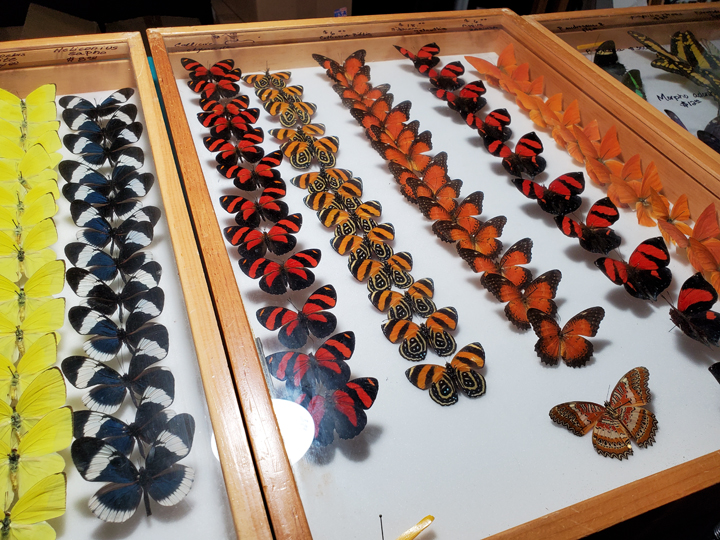
From carnivorous plants and tarantulas, to caterpillars, mounted butterflies, and much more, the annual Bug Fair at the Natural History Museum of Los Angeles County, held this year on the weekend of May 20-21, is an insect lovers delight. I try to go every year. Art and I spent the morning at the museum browsing the vendor booths and oohing and aahing at the spectacular displays, along with families with children and eager buyers adding to their own insect collections. 


When we finished we exited through the dinosaur galleries where we could look through the windows at the butterfly house outside below and see gorgeous live blue morpho butterflies fluttering among the plants. Tickets for the butterfly house were sold out so we didn't visit today, but I have enjoyed visiting before. 


Wednesday, August 17, 2022

MEET AUGGIE, CALIFORNIA'S STATE DINOSAUR


Did you know that California had a state dinosaur? Meet Auggie. In September 2017, Augustynolophus morrisi (Auggie's scientific name), was declared the official state dinosaur of California, the only place its fossil bones have been found. It was a large hadrosaur, reaching 26 feet in length and weighed a hefty 3.3 tons. Like all species of hadrosaur, Auggie was a plant eater. Hadrosaurs were one of the few known species of dinosaur that chewed their food.

I first learned about Auggie on a recent visit to the Natural History Museum of Los Angeles County, where numerous Auggie souvenirs are featured in the gift shop. The museum also has an impressive display of dinosaur fossils.

I have always been fascinated with dinosaurs and prehistoric animals and written a number of books about them. Here are a few. You can find these books in your library or as ebooks on Amazon.


Sunday, January 24, 2021

MARY ANNING, FOSSIL GIRL, Discoverer of Ancient Giant Sea Reptiles

Mary Anning. Illustration by Laurie Caple for Giant Sea Reptiles of the Dinosaur Age by Caroline Arnold

Last night I watched the movie Ammonite, about Mary Anning, the woman who made remarkable fossil discoveries of ancient giant sea reptiles along the English coast near Lyme Regis in the early 1800s. I have long been fascinated by Mary Anning and wrote about her in my book GIANT SEA REPTILES OF THE DINOSAUR AGE. It is illustrated with beautiful watercolor paintings by Laurie Caple. (The book is out of print. You can look for it at your library.)


Although Mary Anning had little formal education, she had an uncanny knack for finding fossils and for understanding how the bones fit together. After excavating her specimens, she carefully reconstructed them and made detailed drawings. She collected fossils for many of the leading scientists of the day. Her work helped develop new ideas about what the world was like in prehistoric times.

Ammonites found at Lyme Regis

Many of Mary Anning's discoveries are on display at the British Museum of Natural History in London. Several years ago I visited the museum and was surprised to find a Mary Anning's look-alike sharing some of the fossils with museum visitors. It almost seemed like meeting Mary Anning herself! You can read about that visit in my post at The Intrepid Tourist.


Wednesday, October 1, 2014

Children’s Literature Class, Santa Barbara City College

Earlier this week I had the opportunity to speak to Elizabeth Bowman’s children’s literature class at Santa Barbara City College in Santa Barbara, California.  The students are current or pre-experience teachers at preschool and elementary grades.  They were a lively and appreciative audience with lots of excellent questions.  I talked about my books and life as an author and offered a variety of ways that books like mine can be used in the classroom both for reading and as jumping off places for related projects.  At the end of my presentation the last question was: “As you have visited schools over the years, what is the most memorable question you have had from a student?” I will never forget the student who asked, “If you could be a dinosaur, what kind of dinosaur would you be?”  My answer: a feathered dinosaur!
Thank you Elizabeth for inviting me to your class!

Sunday, July 13, 2014

PTEROSAURS: Rulers of the Skies in the Dinosaur Age now available at StarWalk Kids

One hundred million years ago, the skies were filled with enormous flying reptiles. With wing spans up to nearly forty feet, pterosaurs were one of the dominant life forms on earth.  My book, PTEROSAURS: Rulers of the Skies in the Dinosaur Age, originally published by Clarion, is now available as a digital book at StarWalk Kids and also soon at Amazon as a Kindle book.  I am thrilled to see this book available again.  Through the month of July you can read all of the books in the StarWalk Kids catalogue for free.  It is a great opportunity!

BOOKLIST Review of Pterosaurs
Gr. 2-4. After tackling megalodon, feathered dinos, and woolly mammoths in three previous books, Arnold and Caple add another extinct creature to their repertoire. This solid overview of "the only reptiles ever capable of powered flight" covers pterosaurs' ancestry, their peculiar physiology, theories about their behavior, and major fossil discoveries, frequently making abstract facts concrete through vivid comparisons: "If your arms were built like the wings of a pterosaur, your little finger would be more than 3 feet (1 meter) long!" Descriptions of about 20 of the more than 100 different pterosaur species known today round out the text. Caple's neatly labeled watercolors emphasize clarity over drama, but her subjects' exotic physical oddities (hairy, batlike bodies; toucan-bright beaks; bulbous, gaudily colored crests) will draw kids into the diorama-like tableaus.

Wednesday, September 25, 2013

PAPER PLATE DINOSAURS

Who doesn't love dinosaurs?  First graders at a school I visited read my book Dinosaurs All Around, which tells how artist Steven Czerkas creates life-size dinosaurs for museum displays, and then created their own dinosaurs with paper plates.  The curved edge of the paper plate is perfect for attaching the bony plates on the back of a stegosaurus.  I love the way students gave the dinosaurs all sorts of different colors.

Dinosaurs All Around was published in 1993 by Clarion Books.
Stephen Czerkas's dinosaur models, ranging from the largest carnivores to hatching babies, are widely exhibited in museums. This book is based on a traveling exhibit, "Dinosaurs: A Global View," organized by the Natural History Museum of Los Angeles County and a visit to the artist's studio. Czerkas draws on a painstaking study of fossil bones, living reptiles, and modern animal behavior in the process of putting skin over the bones, choosing color and markings and action poses for the most true-to-life portrayal possible.

Learn how such models are constructed, and the decisions the artist must make in portraying these long-vanished reptiles. Find out how models like these help us to understand what life was like millions of years ago when dinosaurs were alive.

Sunday, July 28, 2013

Activity: Make a Dinosaur Time Line

Many of my books, such as Giant Sea Reptiles of the Dinosaur Age, Pterosaurs: Flying Reptiles of the Dinosaur Age and Dinosaurs With Feathers, are about dinosaurs or animals that lived in the Dinosaur Age (the Mesozoic Era.)  Trying to grasp the huge span of time that these animals were alive--225 to 65 million years ago--and the time that has elapsed since they became extinct is difficult.  One way to appreciate that span of time is to  make a time line of the history of the earth and show when dinosaurs, pterosaurs and giant sea reptiles lived. (Use a roll of shelf paper or draw the time line with chalk on the playground. If one inch equals a million years you will need about 20 feet to go back to the beginning of dinosaurs.)

Would you like to have a pet dinosaur?
Write a story about what you would do if you had a dinosaur, pterosaur, or giant sea reptile as a pet. Where would you keep it? What would it eat?  Do you think you could teach it to do tricks?

Wednesday, January 25, 2012

Meeting a "Real Live Author"

When I was growing up, I never had the chance to meet a “real live author” and it never occurred to me that writing or illustrating books for children was something that I could do for a living.  I hope that some of the children I meet when I do author visits to schools might be inspired to consider writing or illustrating as a career.
     I enjoy school visits because they put me in touch with my audience.  Now that my own children are grown, it is good for me to meet kids, to hear how they talk, find out what interests them, and get a sense of how they are using books like mine. In my presentation, I try to show them that what I do when I write my books is exactly what they do when they are writing a story or report in school.  Just like they do, I start with an idea, then I do research, and then I write, and rewrite, and rewrite, the story.  Recently, at a school visit, one boy asked me what was my favorite part about writing.  My answer was, when I’m done!  Writing is hard work.  A lot of people think that because I’m a professional writer that writing is easy, I do it really fast, and it comes out perfect the first time.  I wish it did.  Writing isn’t easy, I don’t do it fast, and it never comes out perfect the first time.  But when I’m finally done, and every word is just right, it is a terrific feeling.  Then I know the story is ready to go to my publisher, and hopefully, to be made into a book.
     When I visit schools, the kids are always enthusiastic and full of questions at the end of my presentation.  My favorite question came from a boy who wanted to know if I had the chance to meet one extinct animal in real life, what would it be?  I’m still considering the answer.  I’ve written about quite a few extinct animals–dinosaurs, pterosaurs, mammoths, giant sharks, and more, but I’m not sure I’d really like to see a real one up close.  Perhaps a small, feathered dinosaur might be fun.
    For information about my school visit programs and how to book a visit to your school, go to my website at http://www.carolinearnoldbooks.com/schoolvisits.htm .