One of my first illustration assignments was for a book about gardening activities with children. At that time, most books for children were illustrated with black and white art so I made pencil drawings. Here is one of the activities.
Do plants know which way is up and which way is down? Can they detect Earth’s gravity? Here is an experiment that will help you find out.
You will need:
radish seeds
clear glass jars
paper towels
box with a cover
Soak the radish seeds overnight in water. Line a clear jar with a damp paper towel and place the seeds between the towel and the jar, 1 inch from the lip. Keep the towel moist. Stand the jar in inside the box and close the lid to make it dark. When the seeds have germinated (a few days) and their stems extend an inch beyond the top of the jar, place the jar on its side as illustrated. Leave the jar in the dark again. Check the seedlings in a day. Have the stems and roots changed direction? Do you think that plants can feel gravity?
The effect of gravity on plants is called geotropism.
From Children’s Gardens: A Field Guide for Teachers, Parents and Volunteers by Elizabeth Bremner and John Pusey, Illustrations by Caroline Arnold
Wednesday, August 31, 2016
Wednesday, August 24, 2016
SAVING THE PEREGRINE FALCON: a Song to Remember
![]() |
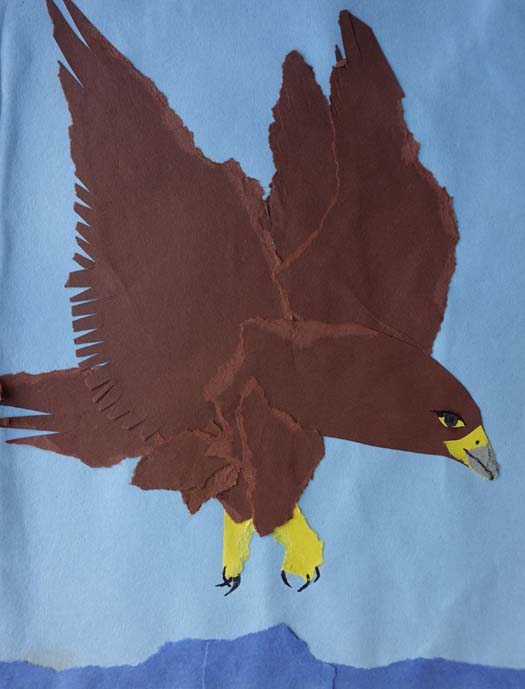
| Peregrine Falcon Art |
Here is the song:
Peregrine Falcon
We are strong falcons,
We are mighty, mighty, mighty, mighty, mighty birds!
But we need your help!
We need your help!
We need your help right now!
We are little peeps,
We are little peeps.
We don't like the DDT that's in our mother's meat!
'Cause it breaks our shells,
It breaks our shells,
It breaks our shells apart!
We are scientists, we are here to help.
We will save you from the DDT!
We'll work together, you will surely see!
Thank you very much!
We were in "double Dutch",
But we're doing better now, we're better, better, now!
CAW CAW CAW CAW CAW CAW CAW CAW
CAW CAW CAW CAW CAW
THANK YOU FOR YOUR BOOK!
WE REALLY TOOK A LOOK!
FIRST GRADE WILL REMEMBER
TO HELP WILDLIFE!
The good news is that peregrine falcons are now (in 2016) no longer on the endangered species list, thanks to no more DDT and the dedicated work of many scientists. My book, Saving the Peregrine Falcon, illustrated with photos by Richard Hewett, is out of print but you may be able to find it in the library.
Wednesday, August 17, 2016
Review of LIVING FOSSILS in Through the Looking Glass Children's Book Reviews
I was pleased to receive this very nice review of my book LIVING FOSSILS: Clues to the Past in the August 3rd issue of Through the Looking Glass Children's Book Reviews.
Living Fossils: Clues to the Past
Caroline Arnold
Illustrator: Andrew Plant
Nonfiction Picture Book
For ages 7 to 9
Charlesbridge, 2016 ISBN: 978-1580896917
Illustrator: Andrew Plant
Nonfiction Picture Book
For ages 7 to 9
Charlesbridge, 2016 ISBN: 978-1580896917
Many
of us have seen fossils in museums; the trilobites and other
insect-like creatures, and the dinosaurs, both small and large. For the
most part these animals looking nothing like any animal that is alive
today. They went extinct long ago and their very distant modern-day
relatives are quite different.
However, there are a few animal species living in the present day that are very similar to their ancient relatives. Their kind survived extinction events and climate change, and they have even survived the assent of mammals. These animals are often called living fossils, and in this book readers will meet a few of these singular creatures.
Perhaps one of the most famous living fossils is the coelacanth. Before the 1930’s scientists thought that this large, marine, lobed-tailed fish had died out sixty-five million years ago. Then a fisherman found a coelacanth in the Indian Ocean and the scientific community went wild speculating about how this animal had survived for so long.
Another species that has remained remarkably unchanged is the horseshoe crab. This animal lived on Earth a hundred million years ago, and it still lives here in the present day.
Many of us will probably never see a live coelacanth or horseshoe crab, but there is one living fossil that most of us are familiar with because they are found all around the world. Two hundred and eighty million years ago large crow-sized dragonflies zipped around marshes preying on smaller insects and other animals. Dragonflies today are a lot smaller, but they still favor environments where there is water, and they are still predators.
Young readers who are interested in fossils and in creatures that lived long ago are going to thoroughly enjoy this book. Readers are shown what six ancient animal species looked like and then they are shown their modern-day counterparts. In addition to telling us about these animals, the text also explains how fossils are formed and how living fossils provide scientists with “clues to the past.”
However, there are a few animal species living in the present day that are very similar to their ancient relatives. Their kind survived extinction events and climate change, and they have even survived the assent of mammals. These animals are often called living fossils, and in this book readers will meet a few of these singular creatures.
Perhaps one of the most famous living fossils is the coelacanth. Before the 1930’s scientists thought that this large, marine, lobed-tailed fish had died out sixty-five million years ago. Then a fisherman found a coelacanth in the Indian Ocean and the scientific community went wild speculating about how this animal had survived for so long.
Another species that has remained remarkably unchanged is the horseshoe crab. This animal lived on Earth a hundred million years ago, and it still lives here in the present day.
Many of us will probably never see a live coelacanth or horseshoe crab, but there is one living fossil that most of us are familiar with because they are found all around the world. Two hundred and eighty million years ago large crow-sized dragonflies zipped around marshes preying on smaller insects and other animals. Dragonflies today are a lot smaller, but they still favor environments where there is water, and they are still predators.
Young readers who are interested in fossils and in creatures that lived long ago are going to thoroughly enjoy this book. Readers are shown what six ancient animal species looked like and then they are shown their modern-day counterparts. In addition to telling us about these animals, the text also explains how fossils are formed and how living fossils provide scientists with “clues to the past.”
Review Written by Marya Jansen-Gruber
Wednesday, August 10, 2016
Book Review in Grinnell Magazine
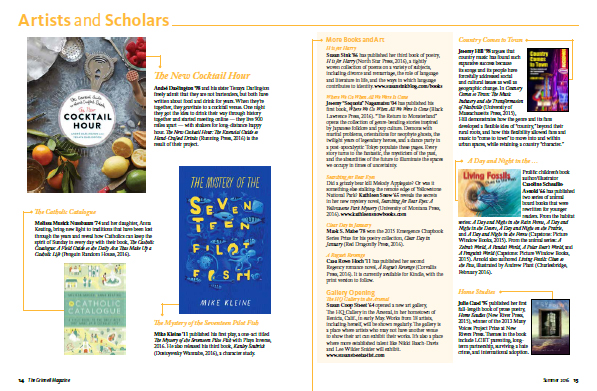
I am pleased to have my books reviewed in the summer issue of the Grinnell Magazine on page 15. I studied art and literature at Grinnell College, Grinnell, Iowa, and graduated with a major in Art. An almost complete collection of my books can be found in the alumni section of the college library.
Here's the announcement of my recent books in the Grinnell Magazine:
A Day and Night in the …
Prolific children’s book
author/illustrator Caroline Scheaffer Arnold ’66 has published two series of animal board books that were rewritten for younger readers. From the habitat series: A Day and Night in the Rain Forest, A Day and Night in the Desert, A Day and Night on the Prairie,and A Day and Night in the Forest (Capstone: Picture Window Books, 2015). From the animal series: A Zebra’s World, A Panda’s World, A Polar Bear’s World, and A Penguin’s World (Capstone: Picture Window Books, 2015). Arnold also authored Living Fossils: Clues to the Past, illustrated by Andrew Plant
Note: Books in the Habitat series are available in hardback, paperback and as e-books; the new books in the animal series are board books, adapted from my earlier series Caroline Arnold's Animals.
Here's the announcement of my recent books in the Grinnell Magazine:
A Day and Night in the …
Prolific children’s book
author/illustrator Caroline Scheaffer Arnold ’66 has published two series of animal board books that were rewritten for younger readers. From the habitat series: A Day and Night in the Rain Forest, A Day and Night in the Desert, A Day and Night on the Prairie,and A Day and Night in the Forest (Capstone: Picture Window Books, 2015). From the animal series: A Zebra’s World, A Panda’s World, A Polar Bear’s World, and A Penguin’s World (Capstone: Picture Window Books, 2015). Arnold also authored Living Fossils: Clues to the Past, illustrated by Andrew Plant
Note: Books in the Habitat series are available in hardback, paperback and as e-books; the new books in the animal series are board books, adapted from my earlier series Caroline Arnold's Animals.
Wednesday, August 3, 2016
SCBWI SUMMER CONFERENCE 2016, Los Angeles, CA
![]() |
| My Workshop at the 45th Annual SCBWI Summer Conference, Los Angeles, CA |
![]() |
| Book Sale and Stairway to the Biltmore Bowl |
![]() |
| Some of the many SCBWI nonfiction writers at the Nonfiction Social |
![]() |
| Lin Oliver, our extraordinary leader and co-founder of SCBWI |
![]() |
| Book Signing in Crystal Ballroom |
Thank you Lin and Steve!
![]() |
| Chocolate pyramid dessert at Golden Kite Awards Dinner |
Labels:
art,
blog,
CA,
cut paper,
Don Tate,
Golden Kite,
illustration,
Lin Oliver,
Los Angeles,
nonfiction,
SCBW,
SCBWI,
Steve Mooser,
Summer Conference 2016,
workshop
Wednesday, July 27, 2016
NYPL Recommends: New Nonfiction for Kids
I was delighted to discover my new book, LIVING FOSSILS: Clues to the Past on the list of books recommended by the staff of the New York Public Library, in a blog post NYPL Recommends: New Nonfiction for Kids written by Lynn Lobash, Manager of Reader Services. In each of six categories–science, biographies, sports, animals, art and other stuff–the library's Best Books for Kids committee has chosen several books. In addition to my book in the science category, the other two titles are: Solving the Puzzle Under the Sea: Marie Tharp Maps the Ocean Floor by Robert Burleigh [Gr. 2 - 4]A beautifully illustrated biography about the first person to successfully map the ocean floor.
and
Professor Astro Cat’s Atomic Adventure: A Journey Through Physics by Dr. Dominic Walliman & Ben Newman [Gr. 2 - 5]A cat explains physics and finally I get it!
These and all of the other books recommended by NYPL look equally fascinating.
I am proud that Living Fossils is included in this list!
and
Professor Astro Cat’s Atomic Adventure: A Journey Through Physics by Dr. Dominic Walliman & Ben Newman [Gr. 2 - 5]A cat explains physics and finally I get it!
These and all of the other books recommended by NYPL look equally fascinating.
I am proud that Living Fossils is included in this list!
Wednesday, July 20, 2016
Living Fossils at the Los Angeles Zoo
![]() |
| Zoo Scape, May-June Issue |
Ferns are so common (there are more than 11,000 species worldwide) that it's easy to overlook their remarkable history, which stretches back about 400 million years. Ferns predated flowering plants and were the dominant botanical life form during the Carboniferous era 360 to 286 millions years ago when flying insects and reptiles first appeared.
Take a look around YOUR neighborhood. Chances are that you have some living fossils growing near where you live!
![]() |
| Ferns in my front garden |
![]() |
| The Nautilus is a living fossil |
Labels:
cycads,
dawn redwood,
ferns,
ginkgo,
LIVING FOSSILS,
Los Angeles Zoo,
Zoo Scape
Subscribe to:
Posts (Atom)