Which came first, the chicken or the egg? A chicken lays an egg, a chick grows inside, hatches, grows to be a chicken--that lays another egg. And so on, and so on.
There are many ways to illustrate the repeating process of a chicken's life cycle. In one classroom of second graders at a school in California, the children made a mixed media presentation using packing material to represent the chicken’s nest, real feathers on the growing chick, a hand-print to make an adult chicken, markers for drawing, and googly eyes for all. With black arrows indicating the circular process, it is a dramatic and colorful presentation.
To do this project you will need:
White poster board or heavy paper cut into a large egg shape.
White paper for the eggs.
Yellow paper for the chick.
Colored markers.
Googly eyes.
Feathers.
Packing material for nest.
Red poster paint.
Use the picture above as a guide.
Have fun!
Learn about a chicken's life cycle in my book HATCHING CHICKS IN ROOM 6.
Showing posts with label nest. Show all posts
Wednesday, July 8, 2020
Saturday, March 15, 2014
BALD EAGLE AND EGGS Coloring Page
It's nesting time for bald eagles!
Bald eagles usually lay two or three eggs in their nest. The male and female take turns sitting on the nest to keep the eggs warm and moist. Inside each egg an eagle chick is growing. It hatches in about five weeks after the egg has been laid.
You can learn more about bald eagles in my book A BALD EAGLE'S WORLD (Picture Window Books, 2010.)
To download a coloring page of a bald eagle at the nest, click here.
UPDATE March 2015: Both nests on Catalina Island now have eggs, due to hatch around the beginning of April. You can watch activity at the nests on live video cams.
Bald eagles usually lay two or three eggs in their nest. The male and female take turns sitting on the nest to keep the eggs warm and moist. Inside each egg an eagle chick is growing. It hatches in about five weeks after the egg has been laid.
You can learn more about bald eagles in my book A BALD EAGLE'S WORLD (Picture Window Books, 2010.)
To download a coloring page of a bald eagle at the nest, click here.
UPDATE March 2015: Both nests on Catalina Island now have eggs, due to hatch around the beginning of April. You can watch activity at the nests on live video cams.
Labels:
A Bald Eagle's World,
activities,
bald eagle,
coloring page,
eagle,
eggs,
nest,
project
Sunday, January 12, 2014
Adelie Penguins and Climate Change
Some of the most dramatic evidence of climate change is occurring in the polar regions.
I recently received an email from a teacher in Newton, Massachusetts, telling me how her first graders are reading my book A Penguin’s World as they follow the development of real live penguin chicks growing up at Cape Royds in Antarctica. The students are learning about penguins via the internet with science teacher Jean Pennycook who is spending three months in Antarctica. Students all around the world are able to learn about penguins and follow the research process through the National Science Foundation penguin science program. The students in Massachusetts share the observations of "their" nest (#8) with their project partner, an elementary school in the Republic of Mordovia, Russia. The female is named 'Mordovia' and the male is "Jackson' after their own school name.
Here is a link to photos of the colony and of the nests that are being followed this year.
http://www.penguinscience.com/education/royds_nestcheck.php
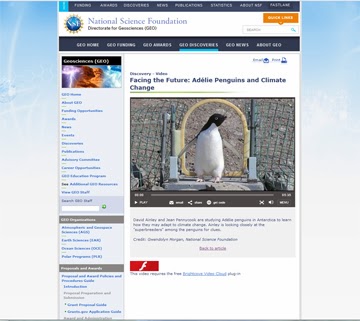
Here is a terrific video explaining the goals of the penguin science program. It has great visuals of penguins at their nests, walking across the ice, and diving and swimming in the ocean.
http://www.nsf.gov/discoveries/disc_videos.jsp?org=GEO&cntn_id=126692&media_id=73765
Labels:
Adelie,
Antarctica,
Cape Royds,
Jackson,
Jean Pennycook,
Mordovia,
National Science Foundation,
nest,
nests,
NSF,
penguins
Subscribe to:
Posts (Atom)