Showing posts with label Antarctica. Show all posts

Sunday, January 12, 2014

Adelie Penguins and Climate Change


Some of the most dramatic evidence of climate change is occurring in the polar regions. 
I recently received an email from a teacher in Newton, Massachusetts, telling me how her first graders are reading my book A Penguin’s World as they follow the development of real live penguin chicks growing up at Cape Royds in Antarctica.  The students are learning about penguins via the internet with science teacher Jean Pennycook who is spending three months in Antarctica.  Students all around the world are able to  learn about penguins and follow the research process through the National Science Foundation penguin science program. The students in Massachusetts share the observations of "their" nest (#8) with their project partner, an elementary school in the Republic of Mordovia, Russia. The female is named 'Mordovia' and the male is "Jackson' after their own school name.

Here is a link to photos of the colony and of the  nests that are being followed this year.
http://www.penguinscience.com/education/royds_nestcheck.php
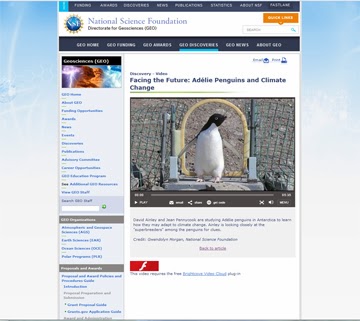
Here is a terrific video explaining the goals of the penguin science program.  It has great visuals of penguins at their nests, walking across the ice, and diving and swimming in the ocean.
http://www.nsf.gov/discoveries/disc_videos.jsp?org=GEO&cntn_id=126692&media_id=73765


Wednesday, February 8, 2012

Project: Icebergs and Sea Level

Do you think melting icebergs raise the sea level?  Do this experiment and find out.
You will need:  a glass bowl, water, ruler, ice cubes
1.  Pour water into the bowl until it is about half full.  Use the ruler to measure the height of the water.
2.  Add the ice cubes.  Measure the water level again.  How much did it rise?  Each ice cube is like a tiny iceberg.
3.  Set the bowl in a warm place until all the ice is melted.  Measure the water level again.  What happened?  (Remember that water increases in volume when it freezes.)

   When a large piece of ice breaks off the edge of a glacier and falls into the ocean, a process called calving, the chunks of floating ice are called icebergs.  In the northern hemisphere, most icebergs break off glaciers in Greenland into the North Atlantic.  Icebergs also form off the coast of Alaska in the Pacific.  In the southern hemisphere, an iceberg the size of Rhode Island recently broke off from Antarctica.  Icebergs drift in the ocen currents until they melt.
   In recent years, the average air temperature of Earth has been going up, and the polar ice sheets have begun to melt.  If melting ice causes sea level to go up by even a few feet, the chance of flooding for coastal cities could increase.  Which cities in the United States could be affected by a sea level rise?

   Read more about icebergs and find other projects in The Geography Book:  Activities for Exploring, Mapping, and Enjoying Your World.

Wednesday, December 28, 2011

Penguin Coloring Page

Pair of Adelie Penguins at their Nest
One of my favorite New Yorker cartoons depicts a penguin colony in which several penguins are posing while another is snapping a photo.  The caption reads: “You didn’t have to spring for colored film!"  Penguins in Antarctica are definitely mostly a black and white picture, and color film would seem to be a waste. (This cartoon appeared before the advent of digital cameras.)  My challenge, when I was illustrating my book A Penguin’s World was to find ways to insert some color into my illustrations.  When I could, I silhouetted the birds against a blue sky or the deep blue of the ocean. The main other color in the book is the pink of the penguins’ beaks and pink feet.  When you color the picture above, see if you can think of any other ways to add color to the scene.
Go to my webpage for A Penguin's World to download the coloring page for the penguins.  You'll also find directions for making a paper bag penguin puppet.
You can also learn about penguins and how they have been impacted by climate change in my new book A Warmer World.