Showing posts with label SLJ. Show all posts

Saturday, April 16, 2022

REVIEW in SCHOOL LIBRARY JOURNAL of KEEPER OF THE LIGHT


The following review, by Elissa Cooper, appeared in the April 1, 2022, issue of School Library Journal.

PreS-Gr 2—In a story inspired by real journals, this picture book gives readers a fictional glimpse into the day-to-day activities of a dedicated lighthouse keeper. In 1902, Juliet Fish Nichols began working at Angel Island to guide ships safely to San Francisco. Set in a journal format, descriptive language and hazy illustrations put the readers in her place as she tends to the mundane, everyday chores, while “the fog, my foe,” is a constant concern. Eventually, the story’s pace picks up when the 1906 San Francisco earthquake hits, followed months later with the lighthouse’s machinery breaking. Every 15 seconds, through a long night, Juliet must strike the bell to warn ships in the fog. Readers will admire her bravery and steadfastness, but might struggle to stay interested during the story’s slower sections. The specialized focus may also narrow the audience to local readers. There are intriguing tidbits dropped along the way, like how both Nichols and her mother were lighthouse keepers at the same time in different locations, but those are not explained until the back matter.

VERDICT For patient readers with a demonstrated interest in lighthouses or historical fiction.


Wednesday, January 26, 2022

SLJ Review of PLANTING A GARDEN IN ROOM 6


The first review is in for my book PLANTING A GARDEN IN ROOM 6 and it's a good one! It's from School Library Journal. I am so pleased! With many thanks to my wonderful editor, Alyssa Pusey, and to Cathleen Schaad for the terrific design of the book.

Arnold, Caroline. Planting a Garden in Rom 6: From Seeds to Salad. photos by Caroline Arnold. 40p. (Life Cycles in Room 6). Charlesbridge. Mar. 2022. Tr $16.99.

ISBN 9781623542405.

PreS-Gr 3–In a relatable tale that combines process and joy, the children of Mrs. Best’s real-life kindergarten class are growing a garden! Arnold has photographed and told their story from beginning seeds to finished salad. The children are taught how to prepare the soil, how to plant the seeds, and how to water and nurture the seedlings. They are taught to keep the strong seedlings and to either compost or feed to the chickens the weaker ones. Mrs. Best explains how ladybugs help keep damaging bugs under control. The children learn what plants need support and to be patient and give everything time to grow. After three months, they are ready to harvest and make a salad for all to enjoy. In the back of the book, readers will find a listing of what parts of plants are edible, what garden tools to use, and common gardening questions. There is a very effective garden vocabulary page, as well as a list of online sources and books for further information.  

VERDICT With photography to illustrate each step, this is a delightful and informative book.


Wednesday, May 8, 2019

REVIEW IN SLJ of BUTTERFLIES IN ROOM 6

The March issue of School Library Journal has another excellent review of BUTTERFLIES IN ROOM 6.

PreS-Gr 2.  Arnold returns to the same classroom she observed in Hatching Chicks in Room 6 (Charlesbridge, 2017). This time she joins Mrs. Best and her kindergarten students as they follow the progress of painted lady butterflies from small blue eggs to adult insects. Photos document the steps required to care for the creatures during their journey from egg to larva to pupa to adult. The intent expressions on the children’s faces reveal their engagement with the process and their delight as they watch the butterflies prepare to fly away. The close-up photos, including the sequence of a butterfly’s emergence from the chrysalis, draw readers into the transformation. The clear, straightforward text is supplemented by facts supplied in small text boxes. A vocabulary list plus suggested books and websites enhance the information. VERDICT. A solid choice for most libraries, particularly those supporting hands-on science learning.
Kathy Piehl, Minnesota State Univ. Lib., Mankato

Wednesday, May 10, 2017

TEACHING IDEAS for Hatching Chicks in Room 6 at the SLJ Classroom Bookshelf

A wonderful article with teaching ideas for my book Hatching Chicks in Room 6 was published yesterday on The Classroom Bookshelf blog of School Library Journal. It is written by Erika Thulin Dawes, a professor of language and literacy at Lesley University. Here is the link: http://www.theclassroombookshelf.com/2017/05/hatching-chicks-in-room-6/ There is a treasure trove of ideas for classroom teachers here. I love that the author, Erika Thulin Dawes,understands how, in a photo essay, the pictures and text work together to tell the story. And I love that she shows how the book can be a springboard for further reading and exploration. In addition to the long list of teaching areas the article also lists book and website resources, has a book review and a section on critical literacy. I am thrilled!

Erika Thulin Dawes is a former classroom teacher, reading specialist, and literacy supervisor, she now teaches courses in children’s literature, early literacy, and literacy methods.

Sunday, August 17, 2014

GRUNT, QUACK, OINK: Focus on Animal Books for Kids in SLJ


Many thanks to Barbara Wysocki for the nice mention, along with authors Gail Gibbons and Seymour Simon, in her July 23, 2014 post in School Library Journal!  I am delighted that nonfiction books like ours, and the wonderful new titles that she lists are becoming a focus of Common Core.  Kids always love learning about animals!

GRUNT, QUACK, OINK: Focus on Animal Books
By Barbara Wysocki

While the nation’s schools align their curricula with the Common Core State Standards (CCSS), school and public librarians serving children remain constant in their task of connecting young people with age-appropriate, meaningful materials. As Olga Nesi, a library services coordinator in the NYC Department of Education, notes, “While public and school librarians differ, our common patron base of children gives both groups fertile ground for growing ever stronger collaborative bonds.” Implementing CCSS for elementary students emphasizes content-rich text, and that means a wider range of carefully chosen nonfiction titles will end up in classrooms, backpacks, and, hopefully, even tucked into suitcases for family vacations. Linda Williams, children’s services consultant for the Connecticut State Library, highlights trade books found through reliable review sources. “Many books are advertised as suitable for Common Core use,” says Williams, “but librarians are looking for high-quality, complex texts.” She sees librarians as being well suited to help teachers find the materials they need, and is developing a webpage to assist in that effort.


As teachers team up with librarians to create go-to book lists and recommended websites, this is a starter set of animal-related nonfiction titles suitable for the elementary set. “Moo” and “Baa” are among a toddler’s first words, so it’s no surprise that young readers are fascinated by critters that swim, hop, and fly. (You’ll find some suggestions for classroom use tucked into the annotations.) While the focus is on outstanding books from the past three years, also recommended are standouts by authors such as Gail Gibbons, Caroline Arnold, and Seymour Simon, who’ve written excellent volumes for years. With a wealth of choices, this list covers a wide range of animals, but does not include insects. The books are divided into land, sea, and air, with a section devoted to more encyclopedic titles.

[Follow the link above for SLJ to see the list of books.]

Sunday, January 13, 2013

StarWalk Kids Review on SLJ EBook Toolkit

StarWalk Kids Media, which features nine of my books in its catalogue and will soon have more, received an extremely positive technical review (including a video walk-through) this week (January 9, 2013) from SCHOOL LIBRARY JOURNAL, the most influential U.S. publication for the institutional buying audience.
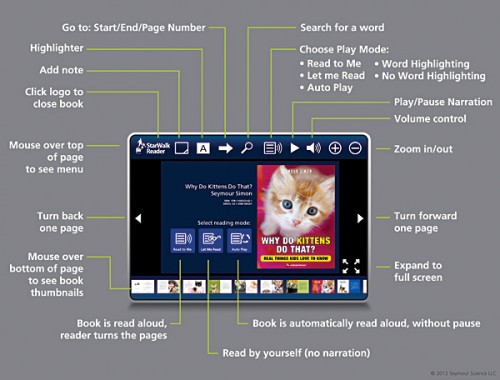
Teachers will appreciate the simple yet robust toolkit built into the StarWalk Reader, which includes the ability to highlight, add notes, zoom in or out, and jump to a page by either entering a page number or mousing over the bottom of the screen to reveal page thumbnails and selecting any of them. Educators and parents can also use StarWalk’s advanced search feature to browse the collection by Lexile level, alphabetic reading level, CC standards, and other criteria.
Here is the link to the whole article.
For more information about StarWalk Kids and to sign up for a free trial, visit www.StarWalkKids.com.