Wednesday, July 25, 2018

TRAPPED IN TAR: Fossils from the Ice Age NOW IN PAPERBACK at Amazon


My book TRAPPED IN TAR: Fossils From the Ice Age , updated and newly illustrated, is now available as a paperback and e-book on Amazon. Originally published by Clarion Books in 1987 with black and white photos by Richard Hewett. In this new version, the text has been updated and is now illustrated with full color photos by Arthur and Caroline Arnold. I am happy to have TRAPPED IN TAR: Fossils From the Ice Age in print again and available to new readers. In the original version my children, Jennifer and Matt, were some of the models. They have now grown up and have children of their own. In the new book, my grandchildren, Alessandra, Lucas and Paige, are in some of the photos, taken on family trips to the tar pits and the George C. Page Museum. I am grateful for their cheerful cooperation! I also thank my son Matt and son-in-law Humberto for their photo contributions.
Arnold family and Columbian Mammoth at the George C. Page Museum
TRAPPED IN TAR: Fossils From the Ice Age is also available on Amazon as an e-book. You can read it with a Kindle app on various devices (I use my iPad) or on your computer.

Between 10,000 and 40,000 years ago, imperial mammoths, giant ground sloths, and sabertooth cats roamed across the continent of North America. Like the dinosaurs that lived millions of years ago, these Ice Age creatures are extinct today. Only their fossil bones remain.
During the Ice Age, over 400 different kinds of animals lived on the grassy plain that is now Los Angeles. Then, as now, pools of tar sometimes seeped to the surface of the earth. Unwary animals stepped into the sticky tar and were trapped. There they died. Gradually their bones sank to the bottom of the tar seep. In time, the tar penetrated the bones and preserved them.
This book tells the story of the Rancho La Brea fossils and examines the work of the paleontologists who excavate and study them at the George C. Page Museum of La Brea Discoveries in Los Angeles, California.

Wednesday, July 18, 2018

DAVID HOCKNEY: 82 PORTRAITS and 1 STILL LIFE at LACMA

David Hockney Portrait Exhibit at LACMA, Los Angeles, CA
"I think I've found something that I could go on with forever, because people are fascinating, they're mysterious really." David Hockney
Entrance to the exhibit with photo of Hockney at work in his studio
If you haven't seen the David Hockney show at LACMA, 82 Portraits and 1 Still Life, I highly recommend it. I went to see it on Sunday. At age 80, David Hockney is still going strong. The portraits are stunning and the red walls of the gallery are a perfect foil for the green and blue background of the paintings.
Julie Green
As I walked around I noticed a woman leading a tour. Then I looked at her dress and realized she was Julie Green, one of the people in the portraits!
Architect Frank Gehry
There are portraits of his studio assistants, massage therapist, housekeeper and cook. Others depict Hockney’s siblings, the children and grandchildren of his friends, and art dealers and prominent cultural figures in Los Angeles. All of the paintings are labeled with the sitter's name and dates of sitting.
Organized by the Royal Academy in conjunction with LACMA, the exhibition opened in London in 2016, then traveled to Venice, Italy; Bilboa, Spain; and Melbourne, Australia. The only U.S. stop is L.A., the city where the portraits were painted and where most of his subjects live.
The 83 paintings line the walls of two large galleries in the Broad Contemporary Art Museum
The series began in 2013 after David Hockney moved to Los Angeles from his home and studio in rural England.
Each person came to Hockney’s studio for two or three days and sat in the same chair on a small platform while Hockney painted. All of the figures are full length and the canvas size is the same for each portrait. The backgrounds are simple–flat color and just a suggestion of shadow on the floor. What comes across in each painting is the distinct personality of the sitter.
The one still life was painted on a day when one of his subjects had to postpone her session. So Hockney set up a bench with pieces of fruit in the same spot in his studio and painted it instead.   

If you haven’t seen this spectacular exhibit you need to go soon. It ends July 29, 2018.


David Hockney: 82 Portraits and 1 Still-life
April 15, 2018–July 29, 2018


Review in the LA Times by Barbara Isenberg

Wednesday, July 4, 2018

TRAPPED IN TAR: Fossils From the Ice Age is Now Available as an e-Book and Paperback

My book, TRAPPED IN TAR: Fossils From the Ice Age is now available as an e-book on Amazon Kindle. It was originally published by Clarion Books in 1987 and is out of print. That book was illustrated with black and white photos by Richard Hewett. In this new version, the text has been updated and is now illustrated with full color photos by Arthur and Caroline Arnold. I am happy to have TRAPPED IN TAR: Fossils From the Ice Age available to new readers as an e-book. You can read it with a Kindle app on various devices (I use my iPad) or on your computer.

Update as of July 24, 2018: TRAPPED IN TAR: Fossils from the Ice Age is also available as a paperback on Amazon.

Between 10,000 and 40,000 years ago, imperial mammoths, giant ground sloths, and sabertooth cats roamed across the continent of North America. Like the dinosaurs that lived millions of years ago, these Ice Age creatures are extinct today. Only their fossil bones remain.
During the Ice Age, over 400 different kinds of animals lived on the grassy plain that is now Los Angeles. Then, as now, pools of tar sometimes seeped to the surface of the earth. Unwary animals stepped into the sticky tar and were trapped. There they died. Gradually their bones sank to the bottom of the tar seep. In time, the tar penetrated the bones and preserved them.
This book tells the story of the Rancho La Brea fossils and examines the work of the paleontologists who excavate and study them at the George C. Page Museum of La Brea Discoveries in Los Angeles, California.

Wednesday, June 27, 2018

UCLA CLARK LIBRARY, Tea and Shaw in the Garden

UCLA William Andrews Clark Memorial Library
Last Sunday, my husband and I and several friends had a lovely afternoon in the garden of the UCLA William Andrews Clark Memorial Library enjoying a tasty afternoon tea as we listened to a lively reading by the Chalk Repertory Theatre of George Bernard Shaw's play Misalliance.
Cast of Misalliance (Chalk Repertory Theatre)
Before the play began we picked up our box of tea sandwiches and cup of tea (or lemonade) to enjoy under the shaded tent.
Tea sandwiches, strawberries and a scone
This was my first visit to the Clark Library, located in the West Adams district. The library is for researchers, but the beautiful 5 acre grounds, basically a park, are open to the public. The library, built in 1926, is a handsome brick structure modeled on other specialty libraries such as the Newberry Library in Chicago and the Morgan Library in New York. It is surrounded be spacious lawns, walkways, flower gardens and various nooks with sculptures and fountains.  I love the sundial "When the sun is not shining, I do this for fun."
Sundial sculpture by Eric Gill
The William Andrews Clark Memorial Library, which is administered by UCLA’s Center for 17th- & 18th-Century Studies, is located on a historic, five-acre property in the West Adams neighborhood of Los Angeles. The rare book and manuscript library specializes in the study of England and the Continent from the Tudor period through the long eighteenth century. Other subject strengths include Oscar Wilde, book arts, and Montana and the West. The Clark is open to students, professors, and scholars throughout the world and serves as the research laboratory for a distinguished array of fellows working either in early modern studies or the fin-de-siècle world of Oscar Wilde.
East lawn of the library grounds
Tours can be arranged by appointment. My writer friends and I plan to make this an expedition sometime in the near future.
                   

Wednesday, June 20, 2018

READING TAKES YOU EVERYWHERE: Author Visit at Encino/Tarzana Library for Summer Reading Program

Encino/Tarzana Branch of the Los Angeles Public Library
Yesterday afternoon I spent a wonderful hour with kids and their parents at the Encino/Tarzana Public Library in Los Angeles giving a presentation as part of the LAPL summer reading program for kids. The theme this year is “Reading Takes You Everywhere” and my books are a perfect example of all the different places you can go when you read about animals. We started with a virtual trip to Africa as I read A Zebra’s World and we all did a Lion Hunt together. We then talked about birds and I measured the kids wingspans. The kids also helped me sing the Wiggle and Waggle song, along with my Wiggle and Waggle sock puppets.
With Star Volunteer, Masha. A STAR Volunteer Reader is a volunteer who reads books and tells stories with children at their local library. They serve as positive role models for children. They commit 2 hours per week for at least 6 months.
During my visit I enjoyed meeting Jennifer, the new head librarian, as well as one of the teen volunteers who helped with my program, and a devoted Star reading volunteer who works with kids at the library every week. I thank Shokoufeh Moghta, the children’s librarian, for inviting me to the library and organizing the event. From the enthusiastic participation of the kids and good questions at the end, I know the afternoon was enjoyed by all!

Wednesday, June 13, 2018

OBSERVING OUR OWN NATURAL HISTORY at Esperanza Elementary School, Los Angeles, CA

The natural habitat garden at Esperanza Elementary School, Los Angeles, CA
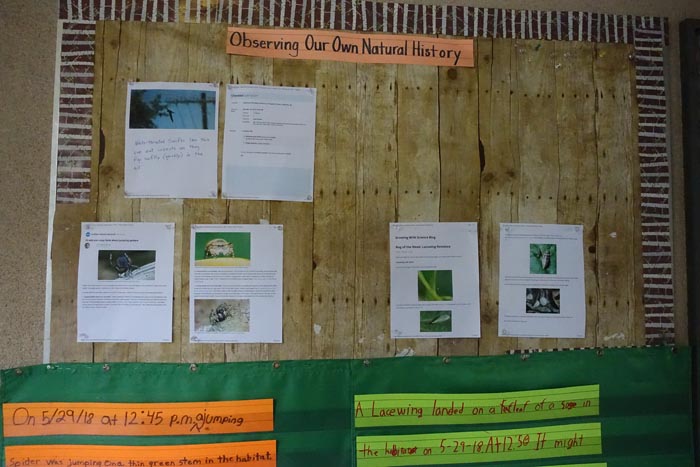
On May 30, 12:55 pm three white-tailed swifts were soaring above the palo verde trees. They look like flying cigars with wings.
This careful description was posted by a student at Esperanza Elementary School in Los Angeles on the school bulletin board “Observing Our Own Natural History” after discovering the birds near the school. Every day, as the students spend time in the school's native plant garden, they are learning to be young scientists and how to look at things closely and observe pertinent details.
Students share information and observations on a bulletin board in the school hallway
A corner of the playground where a building once stood has been turned into a natural habitat–a garden filled with California native plants such as poppies, wild grasses, lupins, sage and more. It is home to birds, butterflies, spiders and a wide variety of insects. The school is in a neighborhood located very close to downtown Los Angeles. The garden provides a refreshing oasis in an otherwise totally urban environment.
A wild grape vine climbs over the garden fence. Skyscrapers loom in the background not far from the school.
When I visited Esperanza last week, a group of third graders working with teacher Elizabeth Williams gave me a tour of the garden. They excitedly pointed out the frothy spittlebug deposits on some of the plants, several spiders, lupins both in bloom and developing seed pods, and a pair of sparrows foraging for seeds–the male with his handsome black markings and the female a duller brown. Then they discovered a pair of house finches carrying nesting material to a nest site. Principal Brad Rumble, who has spearheaded the garden project, met us in the garden. He is an avid birdwatcher and his enthusiasm is contagious. He introduced me to a girl who had observed and identified a white-throated swift and then was excited to find it again in exhibits at the Natural History Museum when the class went on a field trip.
Teacher Elizabeth Williams and Principal Brad Rumble with students
Before we visited the garden, I talked with a group of third grade students in the library and shared the books in my Caroline Arnold’s Habitats series. They had great comments and questions! I plan to go back in the fall when school starts again to do an author visit with more of the students. I love it when kids get excited about the animals that I write about in my books, but I find it even more exciting to see kids learning about nature hands-on--by observing it themselves. The natural habitat garden at Esperanza is a great resource and a wonderful stimulus for learning.
For an excellent video about the Esperanza school garden produced by television station KCET for their Earth Focus series, click on this link: https://www.kcet.org/shows/earth-focus/urban-habitat-esperanza-elementary-school 

Wednesday, June 6, 2018

NEW CHICKS: Author Visit with Campbell Hall Kindergarten Students, Los Angeles, CA

Day-old chicks in the Kindergarten classroom at Campbell Hall
When I first met librarian Linda Pechin at the CLCSC workshop two weeks ago and she told me that the kindergarten students at her school, Campbell Hall, were hatching chicks in their classrooms, it seemed like the perfect opportunity for an author visit. So Linda arranged it, and on Thursday last week I went to the school and had a wonderful time.
Caroline with Linda Pechin, Librarian at Campbell Hall
Both classrooms had incubated eggs so there were two sets of day old chicks peeping in their cages. The children had read my book HATCHING CHICKS IN ROOM 6 and we talked about how their process was similar to that described in the book. We also talked about how they know that chickens are birds–they have feathers and they lay eggs–and then I showed them my feather collection and measured their wingspans. I also shared my ostrich egg. Everyone was impressed that it takes 42 days for an ostrich egg to hatch–twice as long as a chicken egg. The visit ended with a story from my WIGGLE AND WAGGLE book and singing the gardening song. I then went to the library to autograph books.
I thank Linda Pechin and the kindergarten teachers and their students for a very enjoyable visit at Campbell Hall.